How Do Dividends Affect Social Security Benefits?
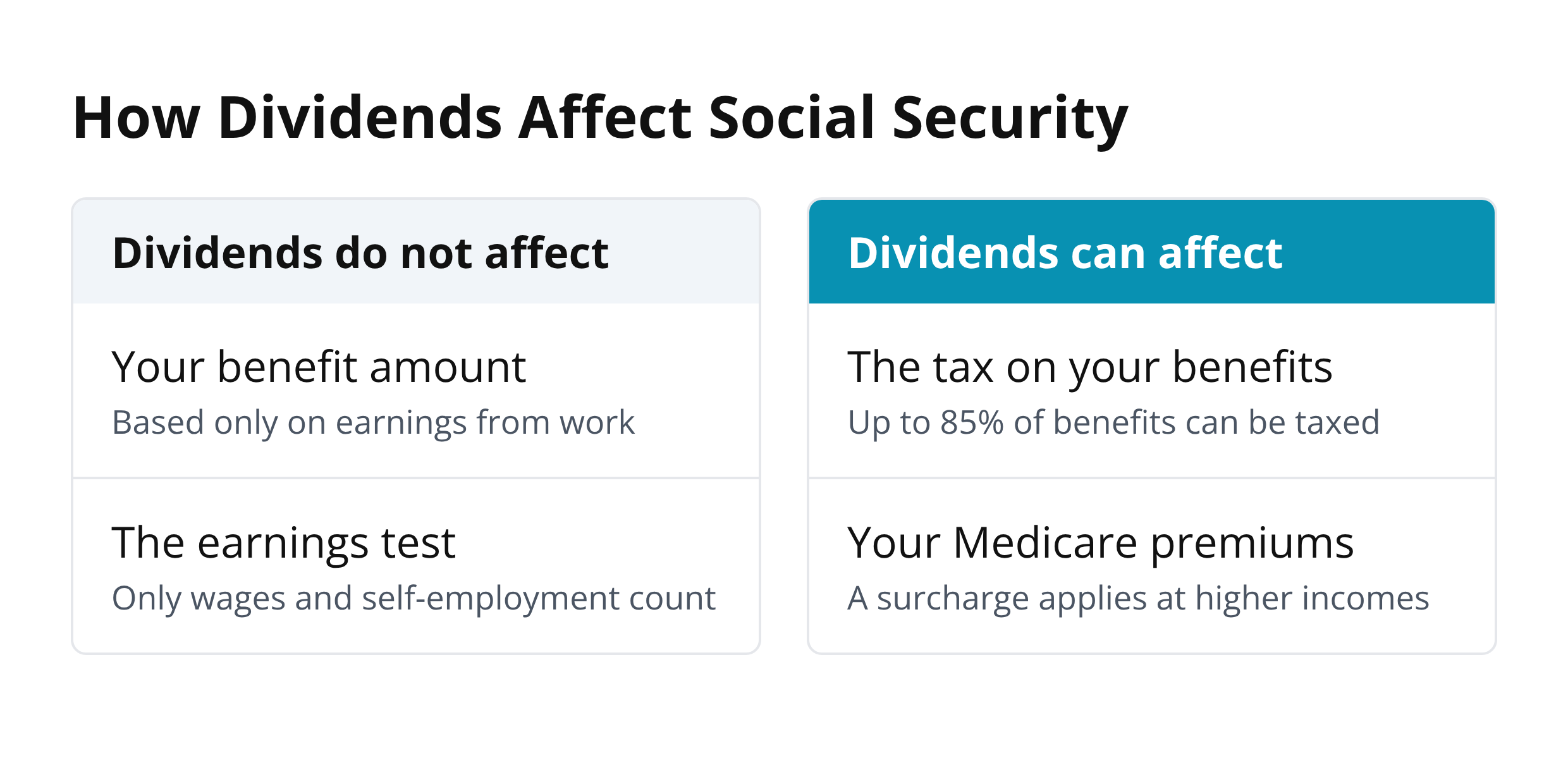
Dividends do not reduce your Social Security benefits. They play no part in how your benefit is calculated.
They also don't count toward the earnings test, which can withhold benefits if you claim early and keep working.
Dividends can affect how much of your benefit you keep, though. The IRS counts them when it decides whether your benefits are taxable.
For a married couple filing jointly, benefits start to become taxable once half of their Social Security plus all other income tops $32,000. Up to 85% can be taxed above $44,000.
Dividends also count toward the income test for higher Medicare premiums, which come out of your Social Security check.
In practice, the tax is often smaller than those thresholds suggest. Using 2026 tax rules, we worked through an example of a retired couple with average Social Security benefits and $40,000 a year of dividends, about what a $1 million portfolio can produce.
Almost half of their benefits became taxable, yet they owed no federal income tax.
Here is how it breaks down.
How Social Security Benefits Are Calculated
Your benefit is based on your earnings from work. Social Security takes your 35 highest-earning years, adjusts them for wage growth, and uses that average to set your primary insurance amount, the monthly benefit you would receive at full retirement age.
Dividends, interest and capital gains play no part in that calculation.
When you claim also matters. Full retirement age is 67 for anyone born in 1960 or later.
You can start as early as 62 for a permanently smaller check, about 30% smaller if your full retirement age is 67. Or you can wait until 70 to earn delayed retirement credits.
Benefits rise each year with inflation. Social Security announced a 3.6% cost-of-living adjustment for 2027 in its 2027 COLA fact sheet.
That lifts the estimated average retirement benefit from $2,095 to $2,170 a month, and the average for a retired couple both receiving benefits from $3,238 to $3,355. The maximum benefit at full retirement age in 2027 is $4,188 a month.
Social Security was not designed to replace a full paycheck, so many retirees use dividends to fill the gap. Our guide on how much you need to retire on dividends covers how to size it.
Do Dividends Count Against Social Security?
No. If you claim before full retirement age and keep working, Social Security's earnings test can hold back part of your benefit. But the test counts only wages from a job and net profit from self-employment.
Social Security does not count pensions, annuities, investment income or interest. Its handbook also lists dividends, capital gains and IRA withdrawals among the types of income that do not count.
For people who still have work income, the 2027 limit is $25,560 a year if you are under full retirement age for the whole year. Above that, Social Security withholds $1 of benefits for every $2 you earn.
In the year you reach full retirement age, the limit rises to $67,920 and the withholding falls to $1 for every $3. Only earnings before the month you reach that age count.
Withheld benefits are not lost. Once you reach full retirement age, Social Security recalculates your benefit to credit you for the months it held back.
So a retiree living on dividends can collect any amount of dividend income without losing a dollar of benefits.
How Dividends Can Make Your Social Security Taxable
Dividends do come into play at tax time. To decide whether your benefits are taxable, the IRS adds half of your benefits to all of your other income, including tax-exempt interest.
That total is often called combined or provisional income. Here are the thresholds from IRS Publication 915:
- Single filers: none of your benefits are taxable if the total is $25,000 or less. Up to 50% can be taxable above $25,000, and up to 85% above $34,000.
- Married filing jointly: none are taxable at $32,000 or less. Up to 50% can be taxable above $32,000, and up to 85% above $44,000.
Every taxable dividend counts toward that total, whether it is qualified or not. So do taxable interest, capital gains, IRA withdrawals, required minimum distributions and the taxable part of a pension or annuity.
The 85% is a limit on how much of your benefit can be taxed, not a tax rate. At most 85% of your benefits are added to your taxable income and taxed at your normal rate.
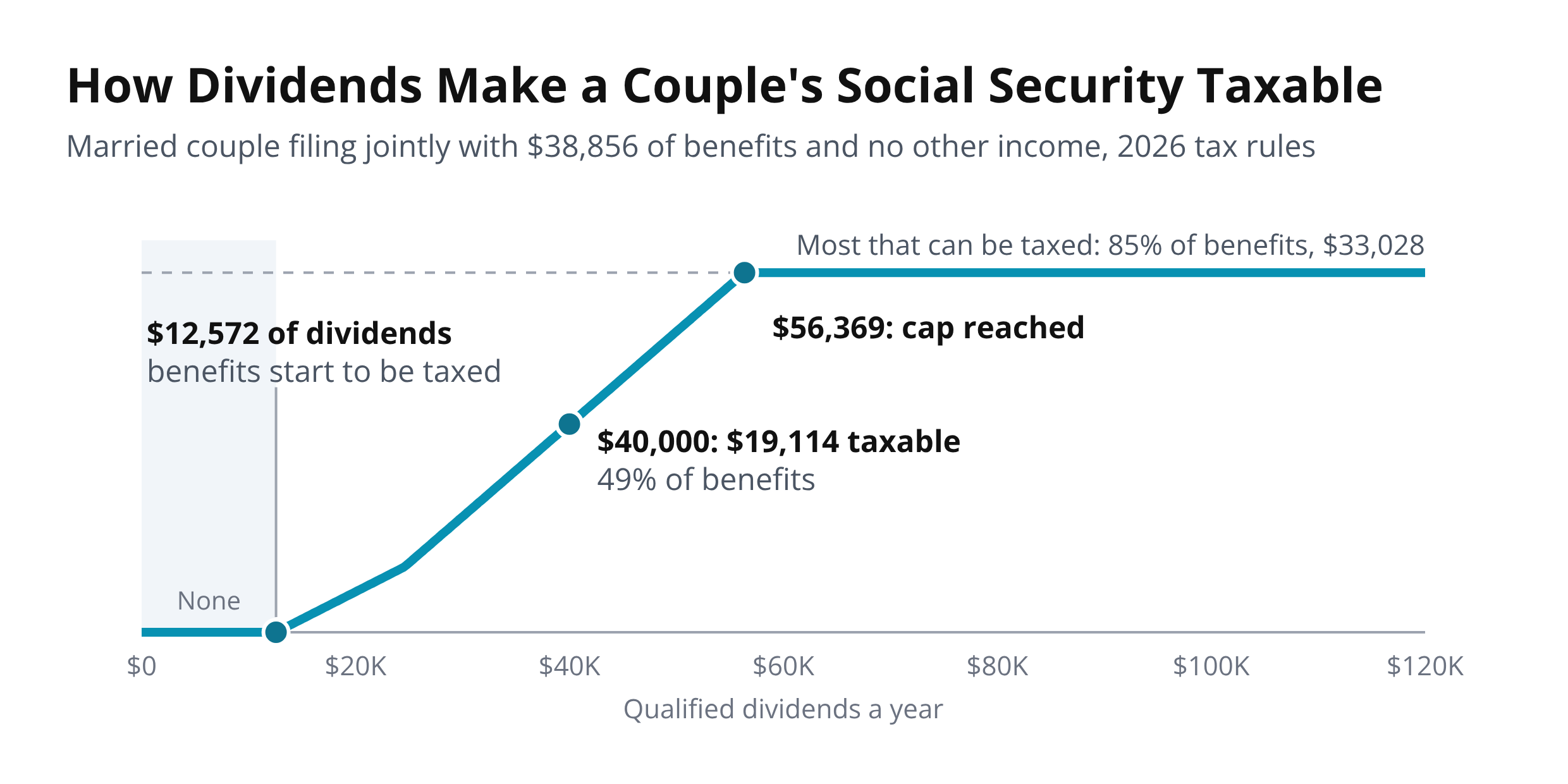
The taxable share also rises gradually. Take a married couple collecting about $38,900 a year in benefits, the average for a retired couple in 2026.
Their first $12,572 of dividends leaves all of their Social Security untaxed. After that, more of their benefits become taxable with each dollar of dividends, until the 85% limit is reached at about $56,400 of dividends.
An Example: A Retired Couple Living on Dividends and Social Security
A taxable benefit doesn't always mean a tax bill. Deductions and the 0% rate on qualified dividends often cover it, as this example shows.
In our video What a $1M Dividend Portfolio Pays Each Month, the diversified $1 million portfolio we built produces just over $40,000 a year of dividends, about a 4% yield. We ran that income through the IRS worksheet for a married couple, both 65 or older, filing jointly with $38,856 of Social Security and no other income.
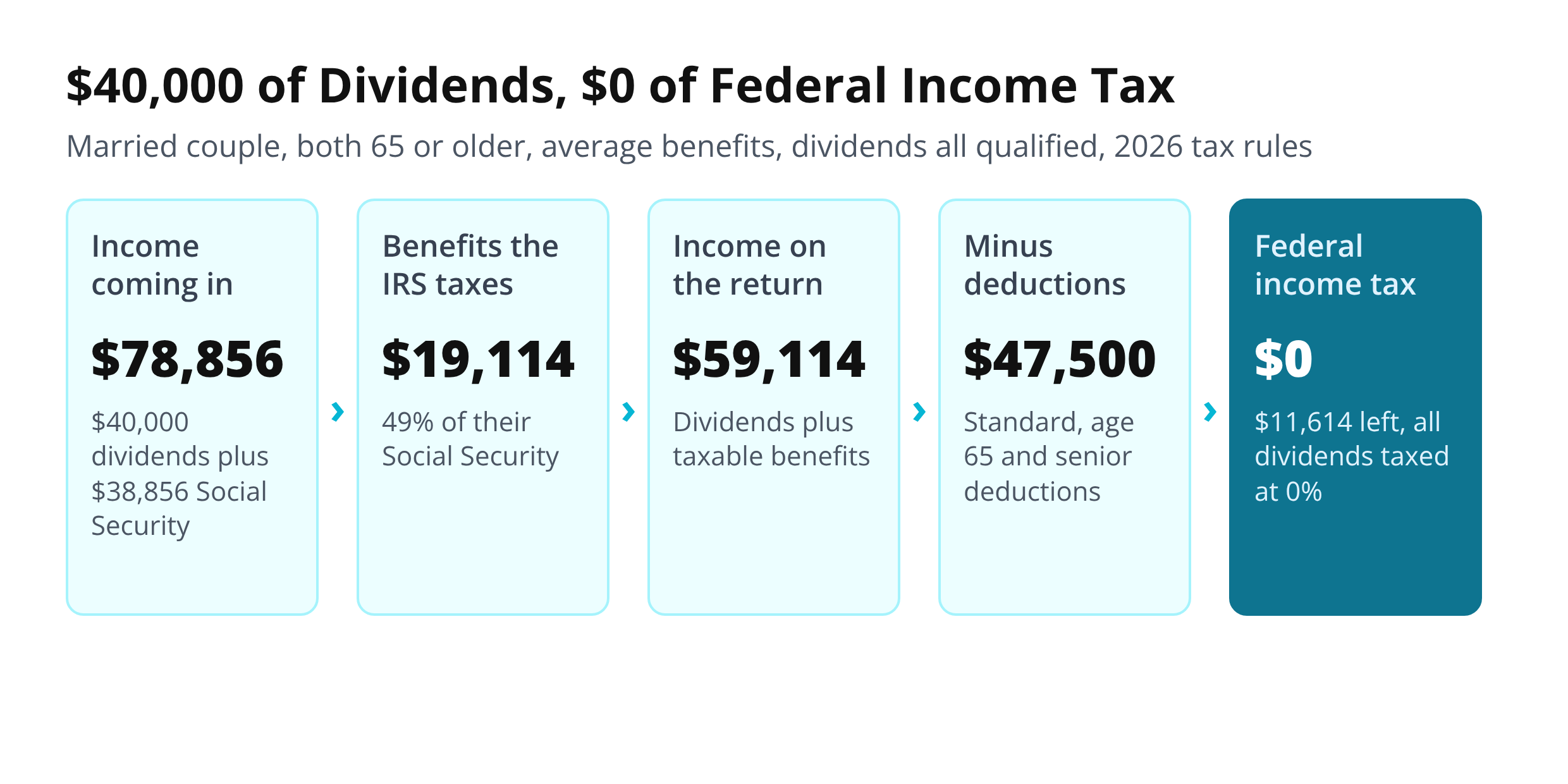
Their combined income is $59,428, which is $40,000 of dividends plus half of their benefits. That is well above the $44,000 threshold.
Following the steps in Publication 915, $19,114 of their benefits becomes taxable, about 49%. That brings the income on their tax return to $59,114.
For 2026, the standard deduction for a married couple is $32,200, plus $1,650 for each spouse 65 or older, according to IRS Rev. Proc. 2025-32.
From 2025 through 2028, the IRS also allows a new $6,000 deduction for each person 65 or older, which phases out above $150,000 of modified adjusted gross income for joint filers. Together, the couple's deductions total $47,500.
That leaves $11,614 of taxable income, all of it from qualified dividends. Qualified dividends are taxed at the lower capital gains rates, and for 2026 the 0% rate applies to married couples with taxable income up to $98,900.
So the couple owes no federal income tax, even with about half of their Social Security counted as taxable.
By the same math, this couple could collect up to about $113,000 of qualified dividends before owing federal income tax for 2026.
Other income changes the result. Non-qualified dividends are taxed as ordinary income, and IRA withdrawals and required minimum distributions add to taxable income too, which leaves less room at the 0% rate.
Some states also tax Social Security benefits under their own rules. Your situation will differ, so treat this as an illustration and check your numbers with a tax professional.
Our guide to qualified dividends explains which dividends qualify for the lower rates.
Dividends and Medicare Premiums
Dividends can also raise your Medicare costs, and most retirees have those premiums taken out of their Social Security check.
The standard Part B premium for 2026 is $202.90 a month. Individuals with modified adjusted gross income above $109,000, and couples above $218,000, pay a surcharge that rises in steps, according to the Centers for Medicare & Medicaid Services.
Prescription drug coverage has a similar surcharge. Both are based on your income from two years earlier, so 2026 premiums generally depend on your 2024 tax return.
The income test also counts tax-exempt interest. One year with a large capital gain or IRA withdrawal can raise your premiums two years later.
If your income has since dropped because of a life-changing event such as retirement, you can ask Social Security for a new decision with Form SSA-44.
Most dividend investors are well below these thresholds. The couple in our example has less than a third of the income that would trigger a surcharge.
Other Retirement Income: What Counts and What Doesn't
The same two tests apply to the rest of your retirement income. Withdrawals from traditional IRAs and 401(k)s, including required minimum distributions, do not count toward the earnings test.
They do count when the IRS decides how much of your Social Security is taxable. Our guide to required minimum distributions covers how dividend investors can plan for them.
Pensions and annuities work the same way. They don't count under the earnings test, but their taxable portion adds to your combined income.
Tax-exempt municipal bond interest counts toward combined income too, even though it isn't taxed itself.
Dividends are not subject to Social Security payroll tax. Social Security says dividends on stock and interest on bonds do not count for Social Security purposes unless you receive them as a securities dealer.
Higher-income investors may owe a separate 3.8% net investment income tax on dividends. It applies once modified adjusted gross income passes $250,000 for married couples filing jointly or $200,000 for single filers, according to the IRS.
What This Means for Choosing Dividend Stocks
Once Social Security is part of your income, three things about your dividends matter more.
How the dividend is taxed. Of the 865 companies we rate, 616 pay dividends we classify as qualified. Most of the 156 non-qualified payers are real estate companies (91) and financial companies such as business development companies and mortgage REITs (63).
Both kinds count toward the Social Security income test. But non-qualified dividends are taxed as ordinary income, so they are more likely to create a tax bill.
Every stock page on Simply Safe Dividends shows how that company's dividend is taxed. Our guide to REIT taxation covers that group in detail.
Whether the dividend will hold. Social Security arrives every month regardless of the economy. Dividends don't come with that guarantee, so the ones you pair with it need to hold up in a downturn.
That is what our Dividend Safety Scores measure. Since 2015, investors who held only stocks with a Safe or Very Safe Dividend Safety Score would have avoided 926 of the 947 dividend cuts we have tracked, or 97%, as our track record shows.
Today 412 of the 865 companies we rate earn a Safe or Very Safe Dividend Safety Score, and 345 of them pay qualified dividends.
Whether the dividend can keep up with inflation. Social Security's last ten cost-of-living adjustments, from 2018 through 2027, added up to about 40%, or 3.4% a year. Over the past decade, the median company we currently rate Safe or better grew its dividend 7.7% a year.
Dividend growth isn't guaranteed the way a COLA is. But steady dividend growers give a portfolio room to raise its income faster than Social Security does.
For more on building that kind of income stream, see our guide on how to live off dividends in retirement.
Frequently Asked Questions
Does dividend income count against Social Security?
No. Social Security's earnings test counts only wages and net self-employment income, so dividends never reduce your benefit, even if you claim before full retirement age. In 2027, only work income above $25,560 a year triggers withholding for early claimers.
No. Social Security's earnings test counts only wages and net self-employment income, so dividends never reduce your benefit, even if you claim before full retirement age. In 2027, only work income above $25,560 a year triggers withholding for early claimers.
Do dividends and interest count as income for Social Security?
Not for your benefit amount or the earnings test. They do count when the IRS decides how much of your benefit is taxable. For a married couple, benefits start to become taxable once half of their Social Security plus all other income, including tax-exempt interest, tops $32,000.
Not for your benefit amount or the earnings test. They do count when the IRS decides how much of your benefit is taxable. For a married couple, benefits start to become taxable once half of their Social Security plus all other income, including tax-exempt interest, tops $32,000.
Does investment income or passive income affect Social Security benefits?
Investment income such as dividends, interest and capital gains does not reduce your benefit. It can make up to 85% of your benefits taxable and, at higher incomes, raise your Medicare premiums.
Investment income such as dividends, interest and capital gains does not reduce your benefit. It can make up to 85% of your benefits taxable and, at higher incomes, raise your Medicare premiums.
Do capital gains affect Social Security?
Capital gains don't count toward the earnings test. They do add to your combined income for taxing benefits, and a large gain can raise your Medicare premiums two years later.
Capital gains don't count toward the earnings test. They do add to your combined income for taxing benefits, and a large gain can raise your Medicare premiums two years later.
Do you pay Social Security tax on dividends?
No. Social Security payroll tax applies to wages and self-employment income, not dividends. Investors with modified adjusted gross income above $250,000 (married filing jointly) or $200,000 (single) may owe the separate 3.8% net investment income tax.
No. Social Security payroll tax applies to wages and self-employment income, not dividends. Investors with modified adjusted gross income above $250,000 (married filing jointly) or $200,000 (single) may owe the separate 3.8% net investment income tax.
Do annuity payments affect Social Security?
Social Security does not count annuities or pensions under the earnings test, so they won't reduce your benefit. The taxable part of those payments does count toward the income that decides whether your benefits are taxed.
Social Security does not count annuities or pensions under the earnings test, so they won't reduce your benefit. The taxable part of those payments does count toward the income that decides whether your benefits are taxed.
How much of my Social Security is taxable if I have dividend income?
Between 0% and 85%. In our example, a married couple with $38,856 of benefits and $40,000 of qualified dividends had $19,114 of benefits counted as taxable, about 49%, and still owed no federal income tax for 2026.
Between 0% and 85%. In our example, a married couple with $38,856 of benefits and $40,000 of qualified dividends had $19,114 of benefits counted as taxable, about 49%, and still owed no federal income tax for 2026.
Closing Thoughts on Dividends and Social Security
Dividends won't reduce your Social Security check, and you can collect as much dividend income as you like without running into the earnings test. They matter at tax time and, at higher incomes, for Medicare premiums.
We think a dividend cut is usually a bigger threat to a retiree's income than the tax on benefits. Pairing Social Security with qualified dividends from financially strong companies helps keep your tax bill low and your income dependable.
If you'd like to see how safe the dividends in your own portfolio are, and how they're taxed, you can see how Simply Safe Dividends works.