MLP stocks, or master limited partnerships, are publicly traded partnerships that pay out most of their cash flow as distributions and send investors a K-1 at tax time. By our count, 25 MLPs that issue K-1s trade on major U.S. exchanges today.
Most own energy infrastructure and act like toll operators. They get paid mainly for the volume that moves through their pipelines and terminals rather than for the price of the commodity. But the group also includes coal and fertilizer producers, fuel distributors, mineral owners and investment firms.
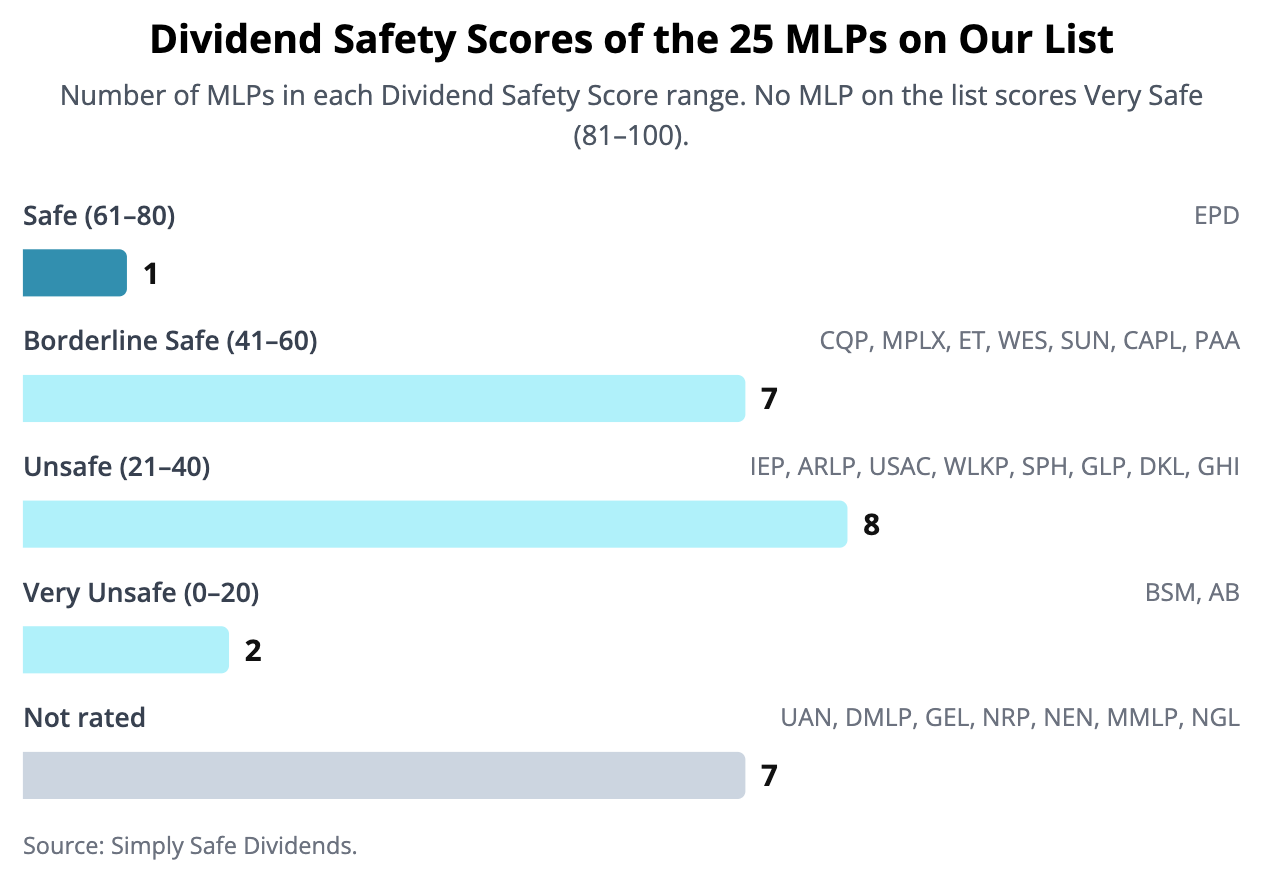
High yields are common among MLPs. Safe ones are not. Only one of the 25, Enterprise Products Partners (EPD), earns a SafeDividend Safety Score. Seven more rate Borderline Safe, ten rate Unsafe or Very Unsafe, and we do not rate the other seven.
The number of MLPs keeps shrinking as partnerships convert to corporations to reach more investors and simplify taxes. Brookfield Business Partners made that switch in March 2026, and Brookfield Infrastructure and Brookfield Renewable plan to follow by the end of the year.
The table below lists every MLP with its current yield and Dividend Safety Score. After it, we explain how the group scores, analyze the five best MLP stocks for income, and review all 25 by industry, ranked from our most to least favorite within each group.
MLPs traded over the counter are excluded given their generally poor trading liquidity.
NGL Energy Partners (NGL) has not paid a distribution on its common units since early 2021, and Martin Midstream Partners (MMLP) pays only a token amount.
Brookfield Infrastructure Partners (BIP) and Brookfield Renewable Partners (BEP) are excluded because both plan to become corporations by the end of 2026. We explain the change below.
A Quick Note on MLP Taxes
Most MLPs issue K-1s rather than 1099 forms at tax time, which makes ownership more complicated because K-1s can be tedious to enter.
Most MLPs issue K‑1s rather than 1099 forms at tax time, increasing the complexity of ownership as K‑1s can be tedious to enter.
Source: IRS
Partnership distributions are commonly treated as a return of capital, which reduces your cost basis and defers taxes until you sell your units or your cost basis reaches zero.
Because return of capital is not taxed right away and MLPs can trigger tax liabilities in tax-sheltered accounts such as IRAs, these investments may be most appropriate for taxable accounts.
How the 25 MLPs Score on Dividend Safety
Taxes aside, the bigger question for an income investor is whether a distribution can last.
Our Dividend Safety Scores weigh payout ratios, debt, recession performance, dividend history and other factors to estimate the risk of a cut over a full economic cycle. Across the 25 MLPs, the results lean cautious.
Enterprise Products is the only MLP that scores Safe, and none scores Very Safe. Seven are Borderline Safe, and all seven own pipelines, terminals or fuel distribution networks. Eight rate Unsafe and two Very Unsafe, often because their cash flow swings with commodity prices or financial markets.
The Dividend Safety Scores of the 25 MLPs on our list, grouped by score range. Source: Simply Safe Dividends.
Which MLPs Kept Paying Through 2020
History helps explain those scores. When oil prices collapsed during the 2020 pandemic, many MLPs cut their payouts to protect their balance sheets.
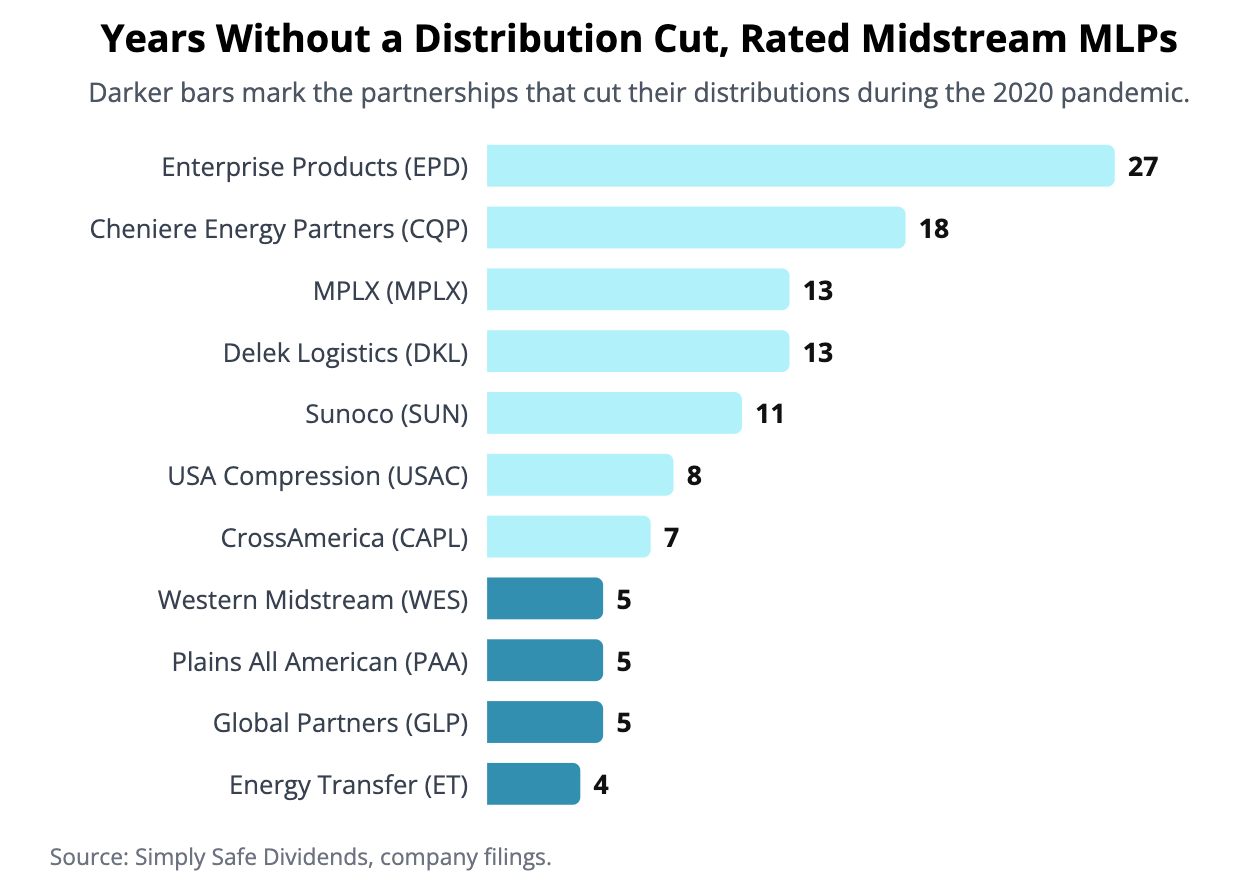
Of the 11 midstream MLPs we rate, seven kept their distributions intact through 2020. Enterprise Products has now gone 27 years without a cut, and Cheniere Energy Partners 18. Western Midstream, Plains All American, Global Partners and Energy Transfer all cut in 2020 and have rebuilt since.
A cut six years ago does not doom a partnership. Energy Transfer and Plains now pay out less than two thirds of their distributable cash flow. But a recent cut is one reason their Dividend Safety Scores sit below Enterprise's.
Years without a distribution cut for the midstream MLPs we rate. Darker bars mark partnerships that cut in 2020. Source: Simply Safe Dividends, company filings.
Brookfield Infrastructure and Brookfield Renewable Are Leaving the MLP List
The MLP universe keeps getting smaller, and converting to a corporation has become the most common way out.
Brookfield Business Partners combined with its corporate twin in March 2026 to form Brookfield Business Corporation, and unitholders received corporate shares one for one.
Brookfield Infrastructure Partners (BIP) and Brookfield Renewable Partners (BEP) announced similar plans in 2026, and both expect to close in the fourth quarter. Each BIP unit and BIPC share will become one share of a new Canadian corporation, and Brookfield Renewable plans the same exchange for BEP and BEPC.
For U.S. investors, the main change is taxes. Shareholders in taxable accounts should receive a 1099 instead of a K-1, and Brookfield expects many to benefit from lower tax rates on future dividends. But because the new companies will be based in Canada, U.S. investors may have 15% withheld from dividends in taxable accounts, which can often be recovered through the foreign tax credit.
Neither company has announced a change to its payout, and we do not expect one since the businesses underneath stay the same. Brookfield Infrastructure keeps its Safe Dividend Safety Score and Brookfield Renewable its Borderline Safe score. A recent selloff in Brookfield Infrastructure's shares, paired with its Safe score, is why we featured its corporate shares in our video 3 Beaten-Down Dividend Stocks With Safe High Yields, which explains why the stock fell and why we think the dividend still looks safe.
How We Picked the 5 Best MLP Stocks
With the Brookfield partnerships set aside, we looked for the MLPs best suited to income investors who want a high yield without excessive risk.
We favored partnerships with investment-grade credit ratings, long-haul pipelines or long-term contracts that protect cash flow from swings in volume, payouts comfortably below our 90% preference for MLPs, and leverage that is low for the industry.
Five stood out. They are listed in order of their Dividend Safety Scores. Western Midstream, Sunoco and CrossAmerica also earn Borderline Safe scores, but Western depends on Occidental Petroleum for most of its revenue, Sunoco carries a below-investment-grade credit rating, and CrossAmerica has no credit rating and has not raised its distribution in five years.
Enterprise Products Partners (EPD): A- Credit Rating and 27 Years of Distribution Raises
Sector: Energy – Midstream Services Dividend Yield: 6.2% Dividend Safety Score:Safe (65) Credit Rating: A- Uninterrupted Dividend Streak: 27 years
Enterprise Products Partners is one of America's largest providers of midstream services. Its pipelines, storage and processing plants handle natural gas, natural gas liquids, crude oil, refined products and petrochemicals across nearly every major U.S. shale basin and the Gulf Coast.
Most of its cash flow comes from long-term, fee-based contracts, many with minimum volume commitments, which insulates it from swings in energy prices. It carries an A- credit rating, and it has raised its distribution for 27 consecutive years, most recently by 2.8% from a year earlier, per its October announcement.
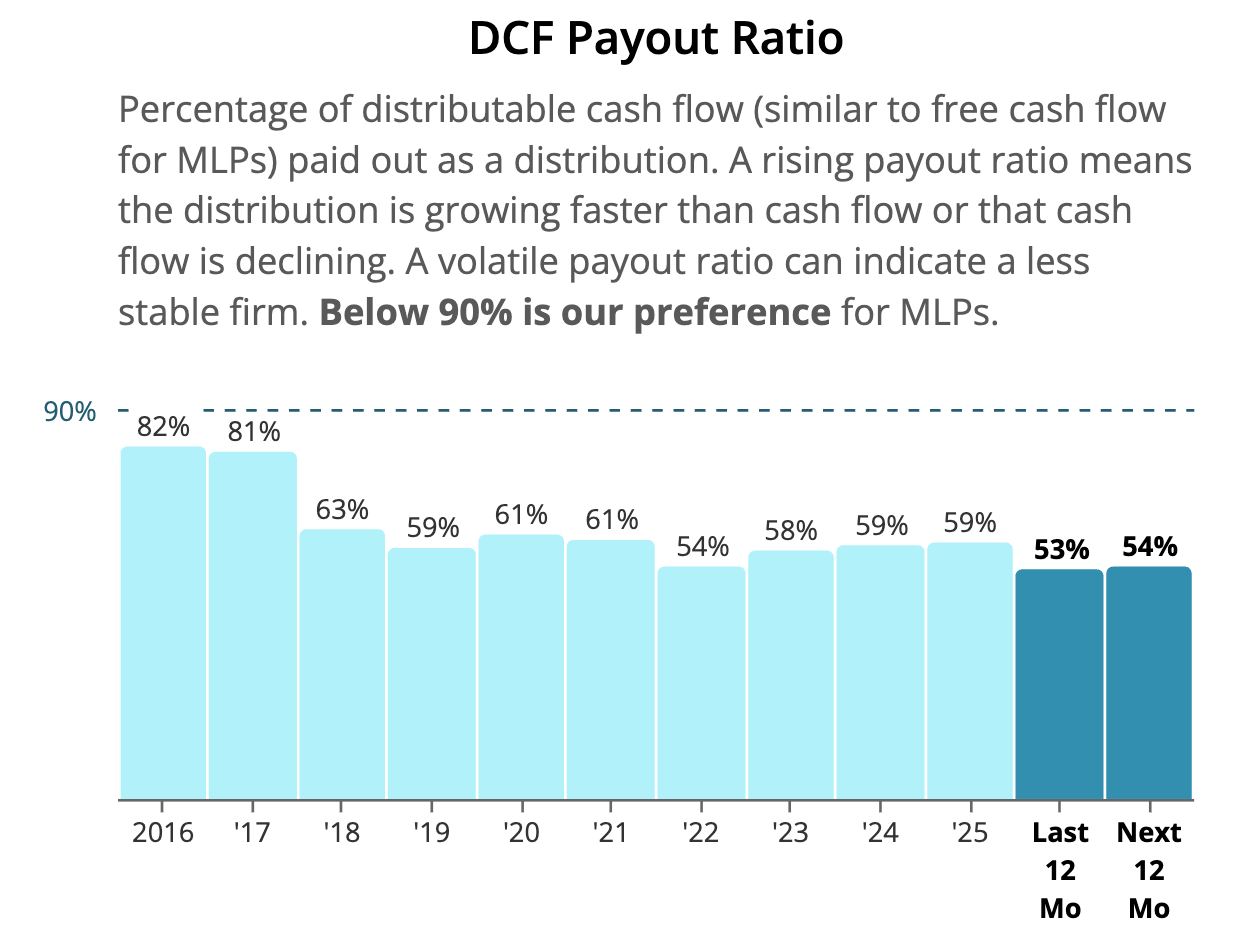
Enterprise paid out 53% of its distributable cash flow over the past 12 months, well below our 90% preference for MLPs. That cushion lets it fund much of its growth without issuing new units, and it even bought back $275 million of units in the first half of 2026.
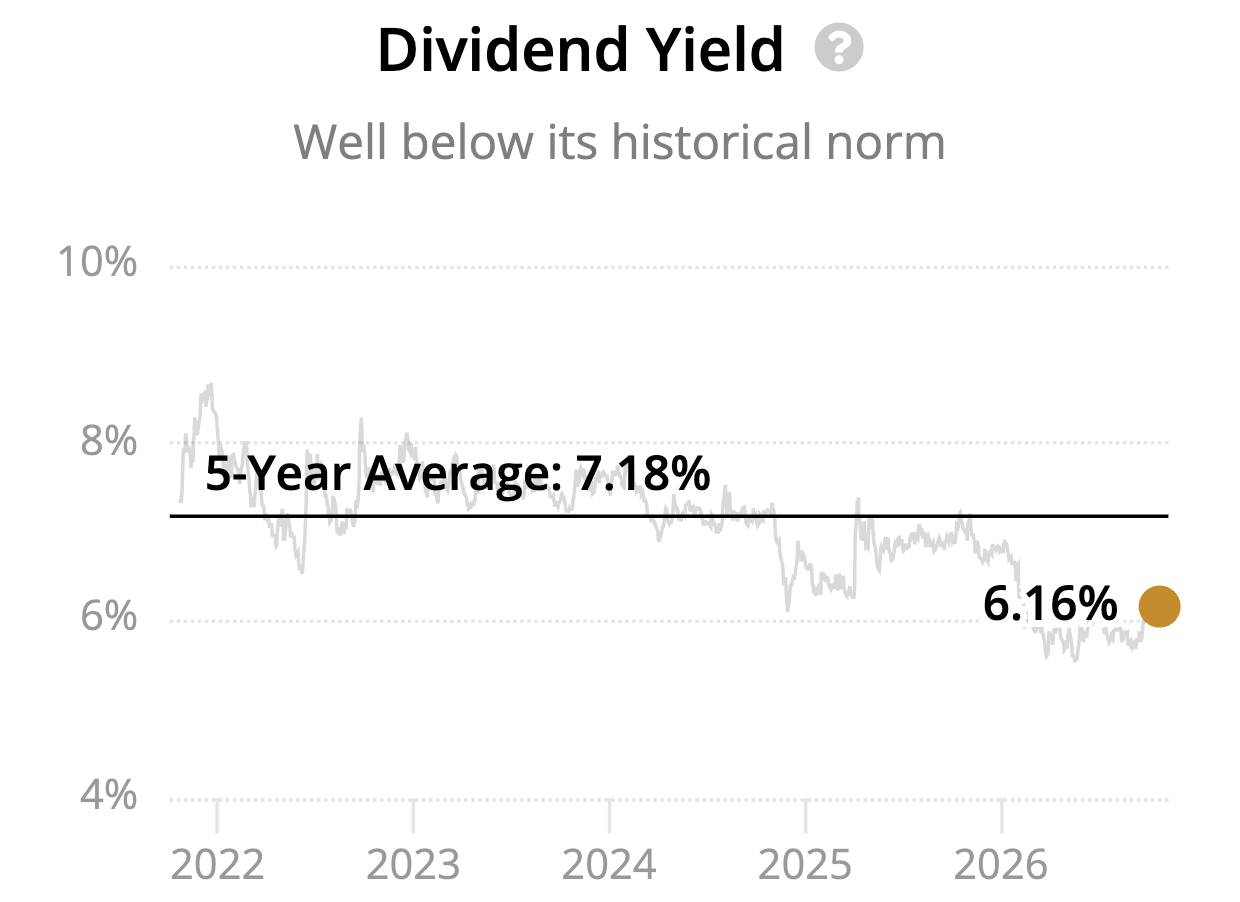
Enterprise yields about 6.2% today, below its five-year average of 7.2%. That suggests the units trade at a richer valuation than usual, so patient buyers may find better entry points.
Enterprise Products Partners' dividend yield compared with its five-year average. Source: Simply Safe Dividends.
Cheniere Energy Partners (CQP): LNG Export Terminal With a BBB+ Credit Rating
Cheniere Energy Partners owns the Sabine Pass liquefied natural gas (LNG) export terminal in Louisiana. It chills natural gas into a liquid so it can be shipped overseas, where buyers turn it back into gas for homes, businesses and power plants.
Most of Sabine Pass's capacity is sold under long-term, take-or-pay contracts, so customers pay fixed fees whether or not they take their cargoes. That has helped the partnership pay uninterrupted distributions since 2007, and S&P upgraded its credit rating to BBB+ in November 2025. Cheniere Energy owns about half of the units.
Its Dividend Safety Score of 60 sits just below our Safe range. The distribution has two parts, a base of $3.10 per unit a year and a variable amount that rises and falls with the terminal's cash flow. Income investors should count on the base and treat the variable portion as a bonus.
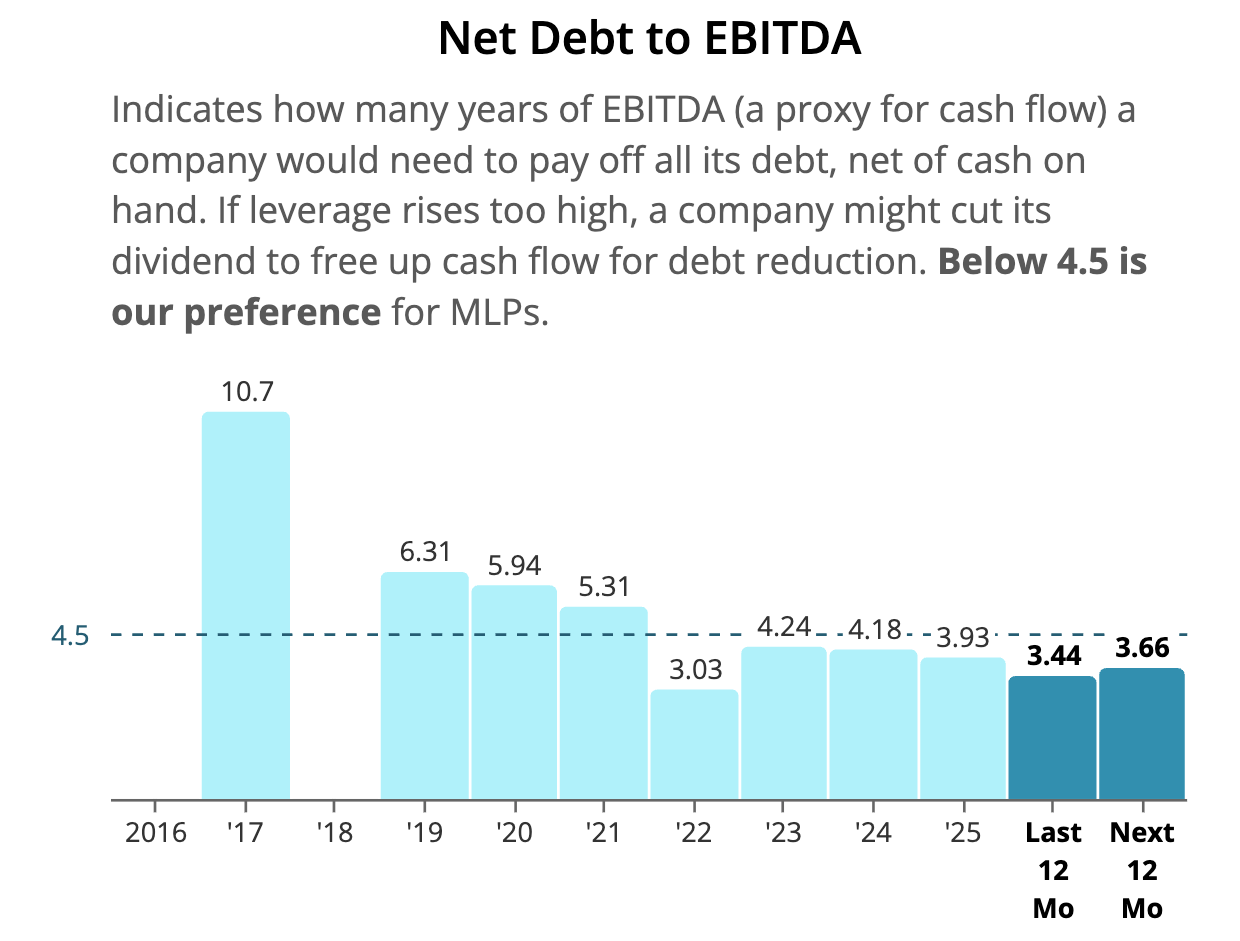
Leverage is the other reason we are comfortable. Net debt has fallen from more than 6 times EBITDA in 2019 to under 4 times, which is very reasonable for an MLP.
Cheniere Energy Partners' net debt to EBITDA. Source: Simply Safe Dividends.
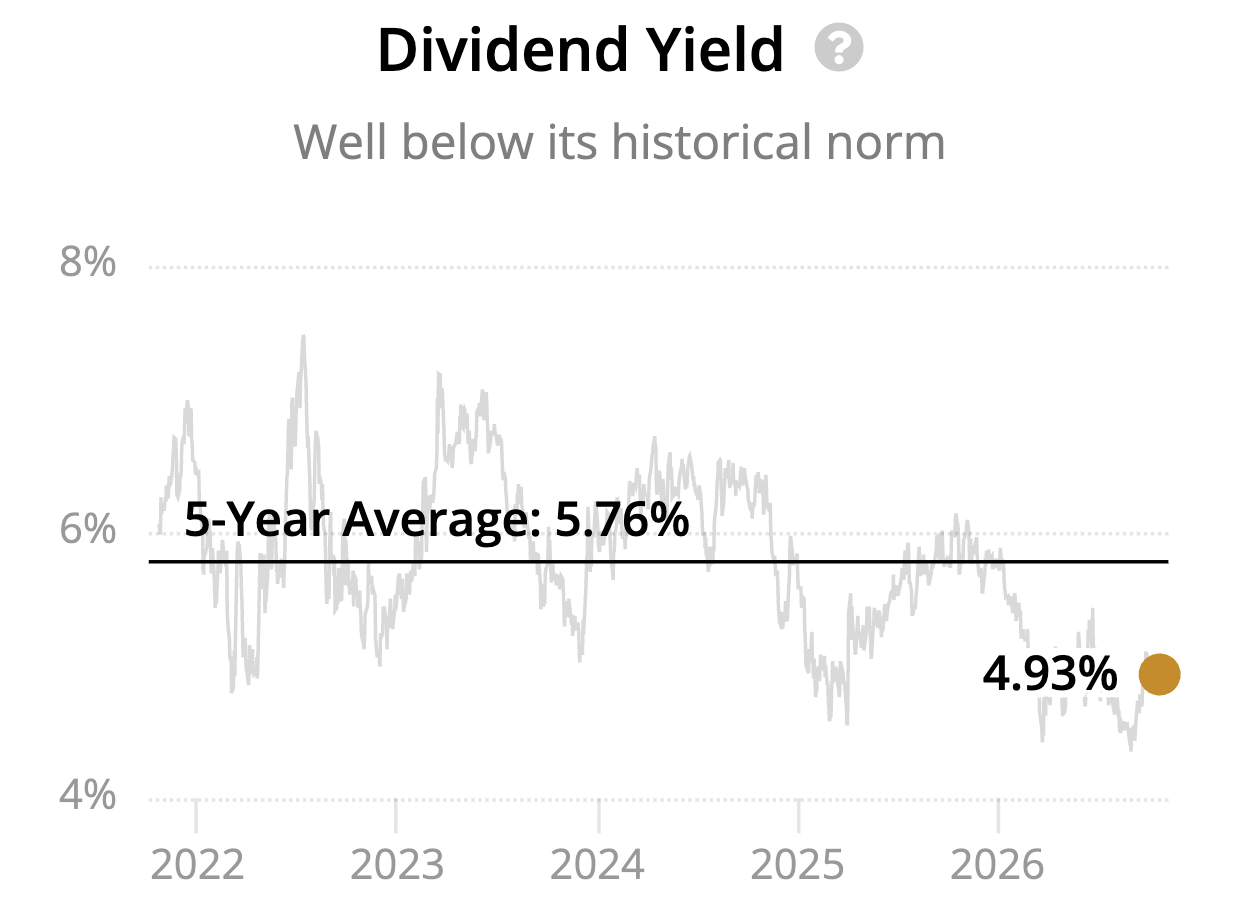
At about 4.9%, Cheniere Energy Partners yields less than its five-year average of 5.8%. Because the variable part of its distribution changes every quarter, its yield moves around more than most, so the comparison is a rough guide to valuation rather than a precise one.
Cheniere Energy Partners' dividend yield compared with its five-year average. Source: Simply Safe Dividends.
MPLX: Marathon Petroleum's Pipeline Partnership, Raising Its Payout 12.5% a Year
MPLX was formed in 2012 by Marathon Petroleum, one of the largest U.S. oil refiners, which still owns about 64% of its units. Much of its business moves crude oil and refined products for Marathon, and most of the rest gathers and processes natural gas.
Long-term, fee-based contracts with minimum volume commitments back most of its work for Marathon, while the gas business carries more exposure to drilling activity. MPLX raised its distribution 12.5% in November 2025 and plans 12.5% raises in 2026 and 2027, according to its second-quarter results.
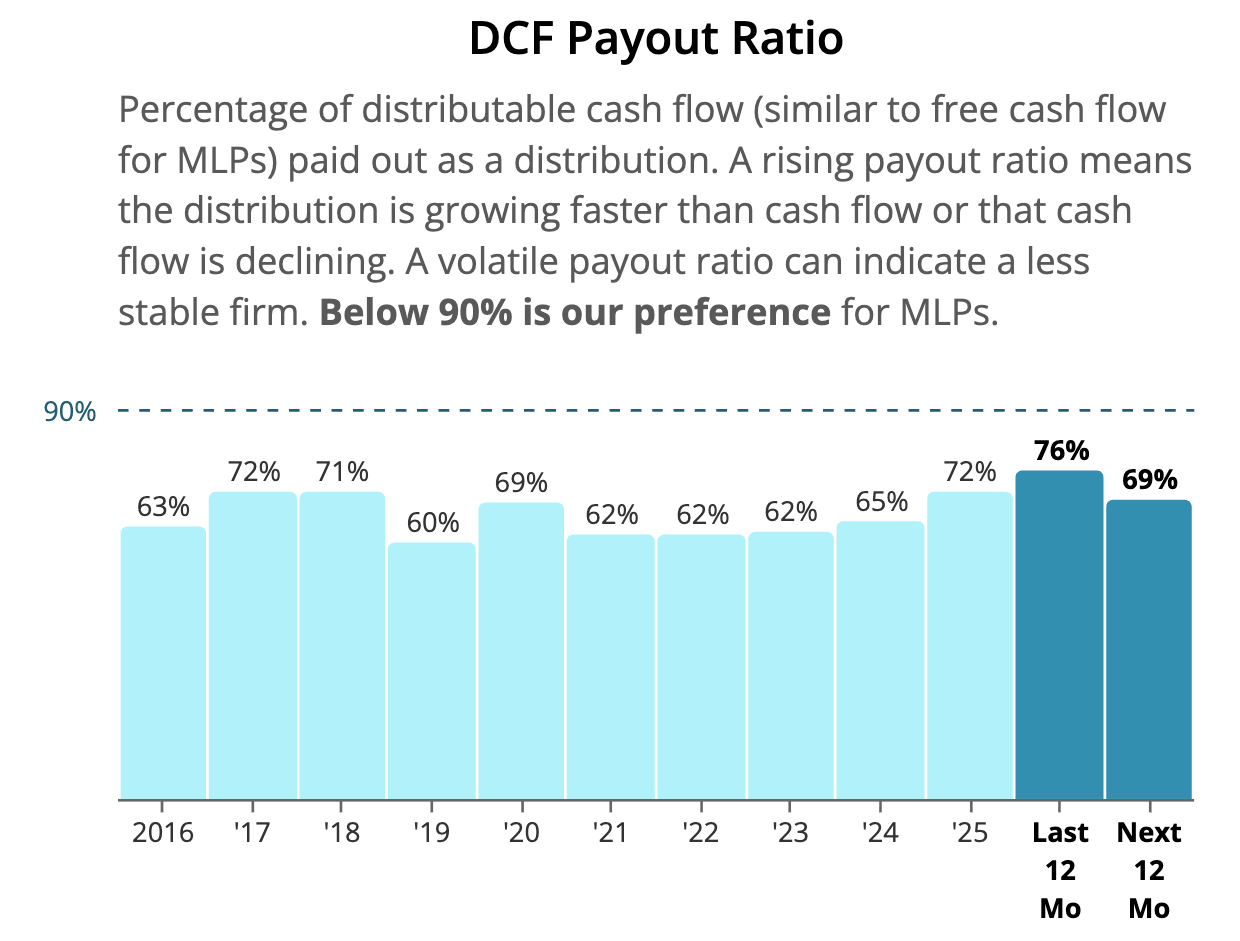
Fast raises are only safe if cash flow keeps up. MPLX paid out 76% of its distributable cash flow over the past 12 months, still under our 90% preference, and its leverage is low for an MLP. The main risk is concentration, since Marathon is both its largest customer and its controlling owner.
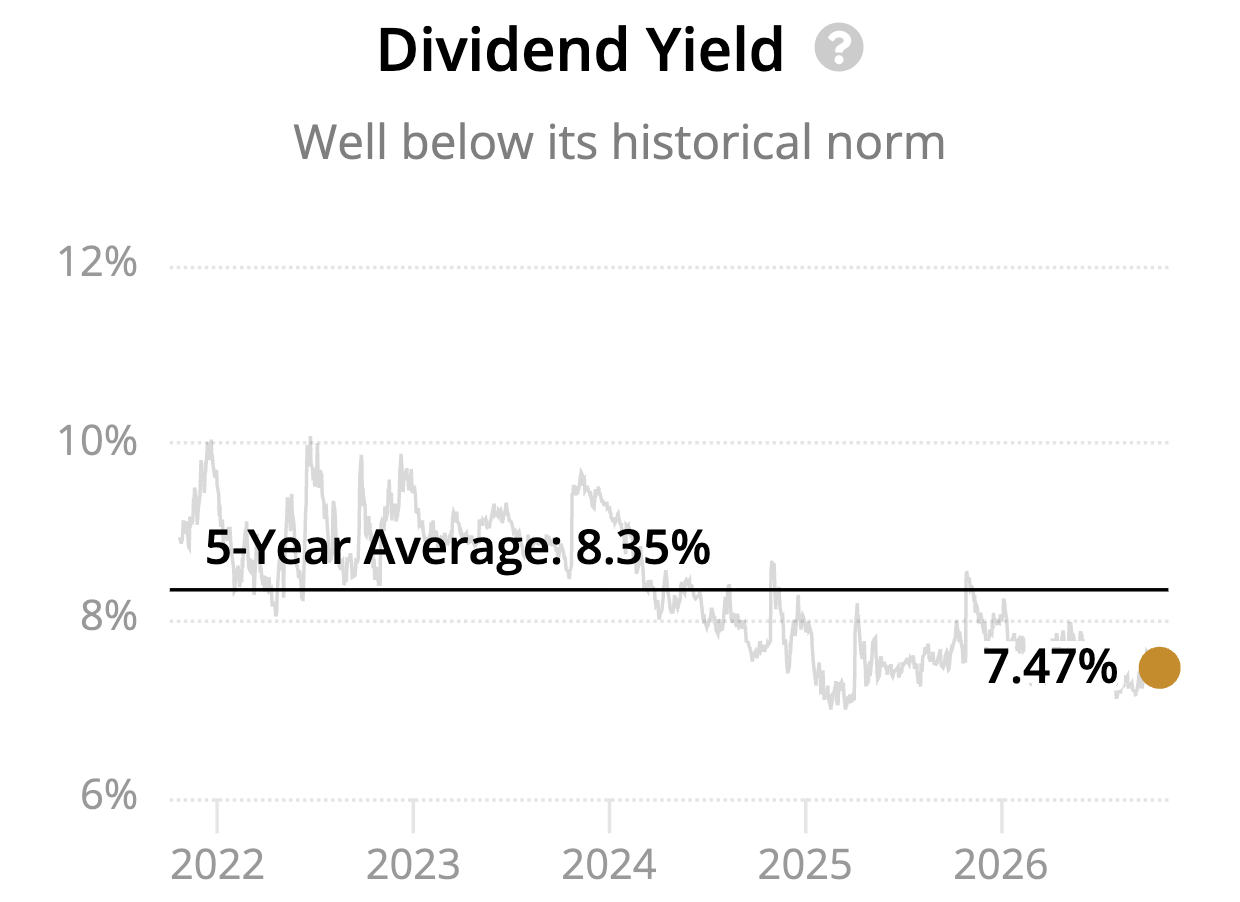
MPLX yields about 7.5%, compared with a five-year average of 8.4%. The unit price has climbed faster than the payout despite double-digit raises, which leaves less room for a bargain than in past years.
MPLX's dividend yield compared with its five-year average. Source: Simply Safe Dividends.
Energy Transfer (ET): Diversified Pipeline Network, Payout Rebuilt After a 2020 Cut
Energy Transfer is one of the largest midstream companies in the U.S., with pipelines, storage and export terminals across the major production basins. Its cash flow is mostly fee-based and spread across natural gas, crude oil, natural gas liquids and refined products.
The partnership cut its distribution in half in 2020 to pay down debt during the pandemic. It has since rebuilt the payout, raising it for 19 consecutive quarters, and targets 3% to 5% annual growth.
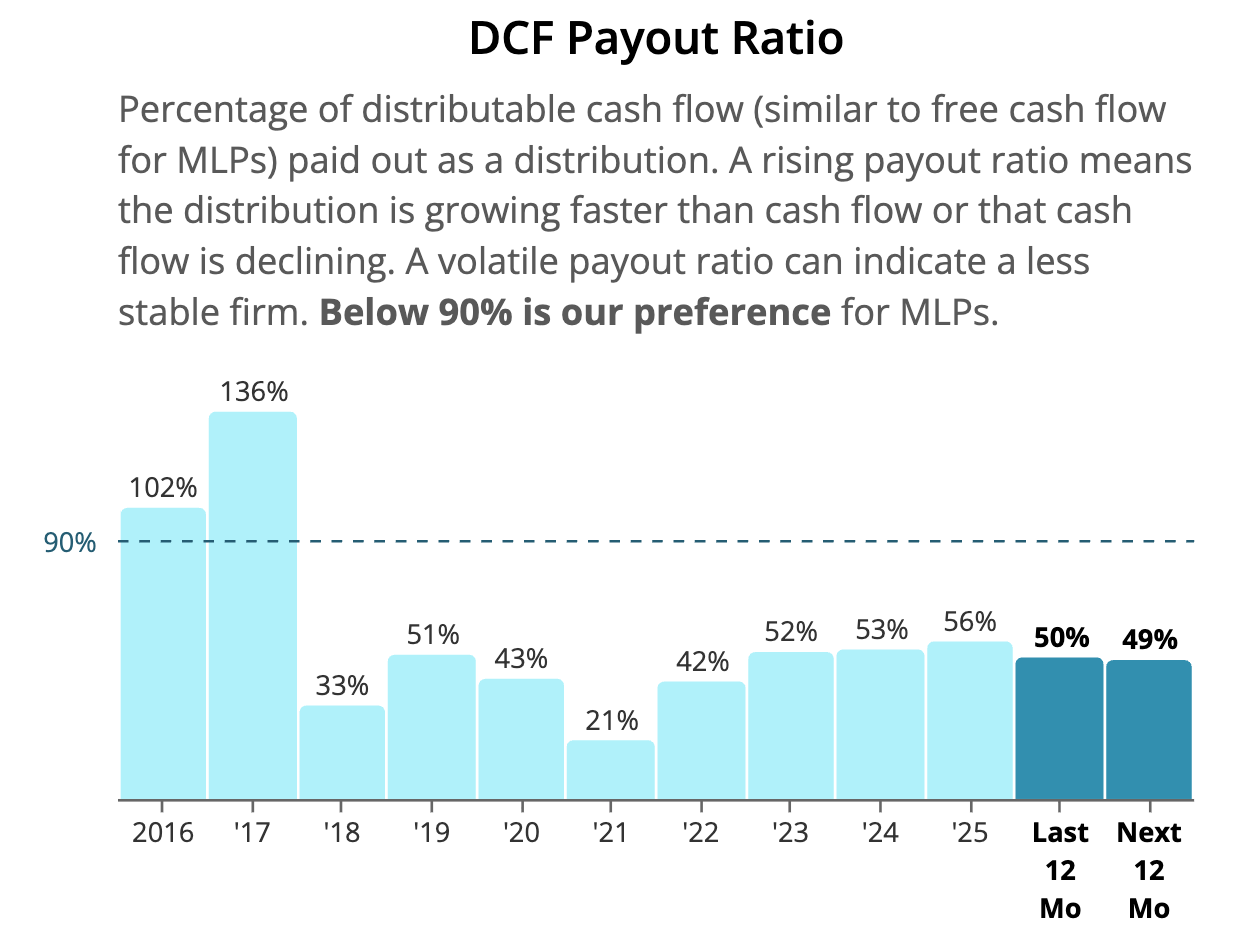
Energy Transfer paid out about half of its distributable cash flow over the past 12 months, which leaves plenty of room to fund growth projects. Management plans $5.0 billion to $5.5 billion of growth spending this year and targets leverage of 4.0 to 4.5 times EBITDA, which sits above some of its peers and weighs on its Dividend Safety Score despite that strong coverage.
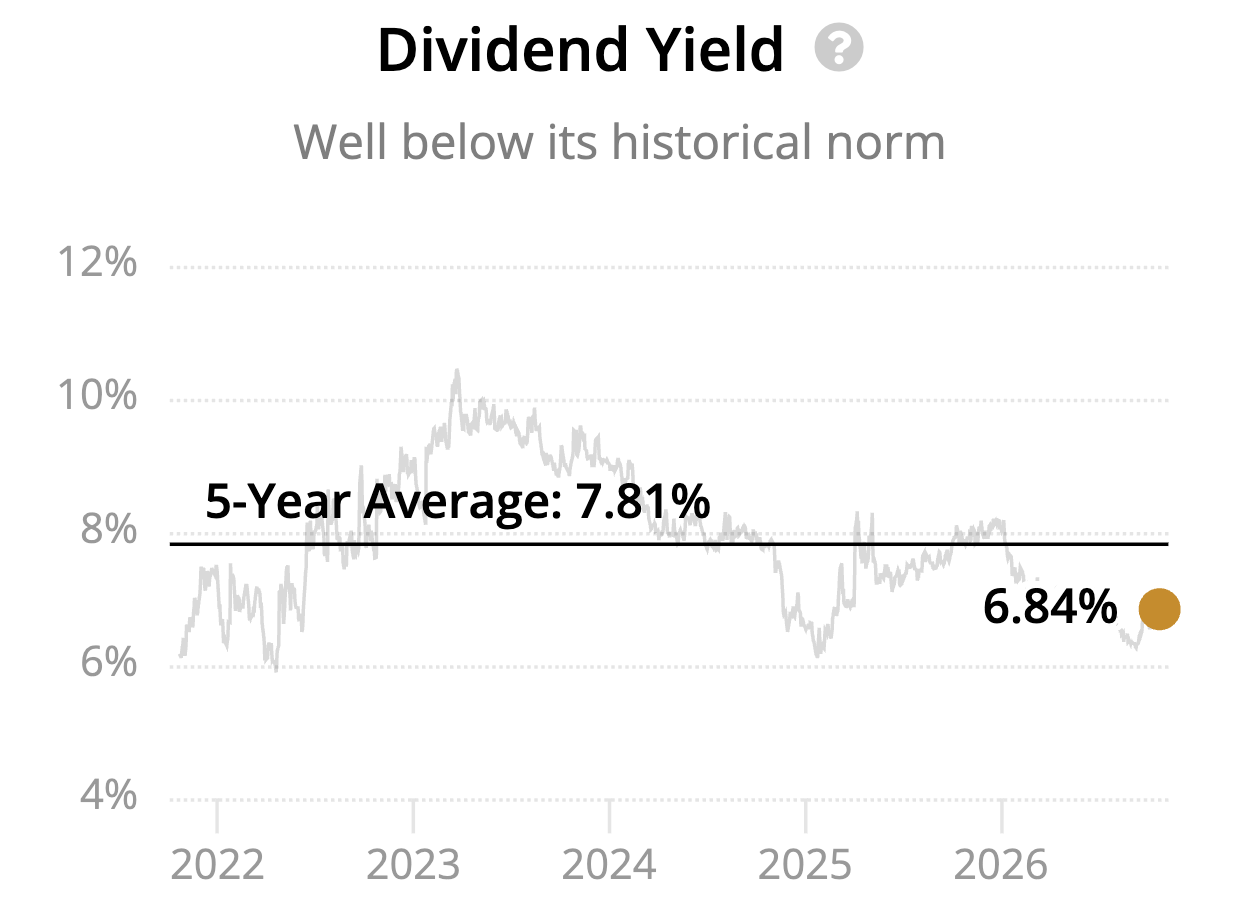
Energy Transfer's yield of about 6.8% sits below its five-year average of 7.8%. The payout was still climbing back from its 2020 cut during the early part of that five-year window, so treat the comparison as a rough gauge of valuation.
Energy Transfer's dividend yield compared with its five-year average. Source: Simply Safe Dividends.
Plains All American Pipeline (PAA): Permian Crude Pipelines With the Lowest Leverage of the Five
Plains All American owns crude oil pipelines, terminals, storage and gathering systems across the major U.S. oil basins, with the Permian Basin in west Texas and New Mexico at the center.
The partnership has reshaped itself over the past year. It bought the EPIC Crude pipeline in late 2025 and sold its Canadian natural gas liquids business to Keyera in May 2026, leaving it more focused on moving crude oil.
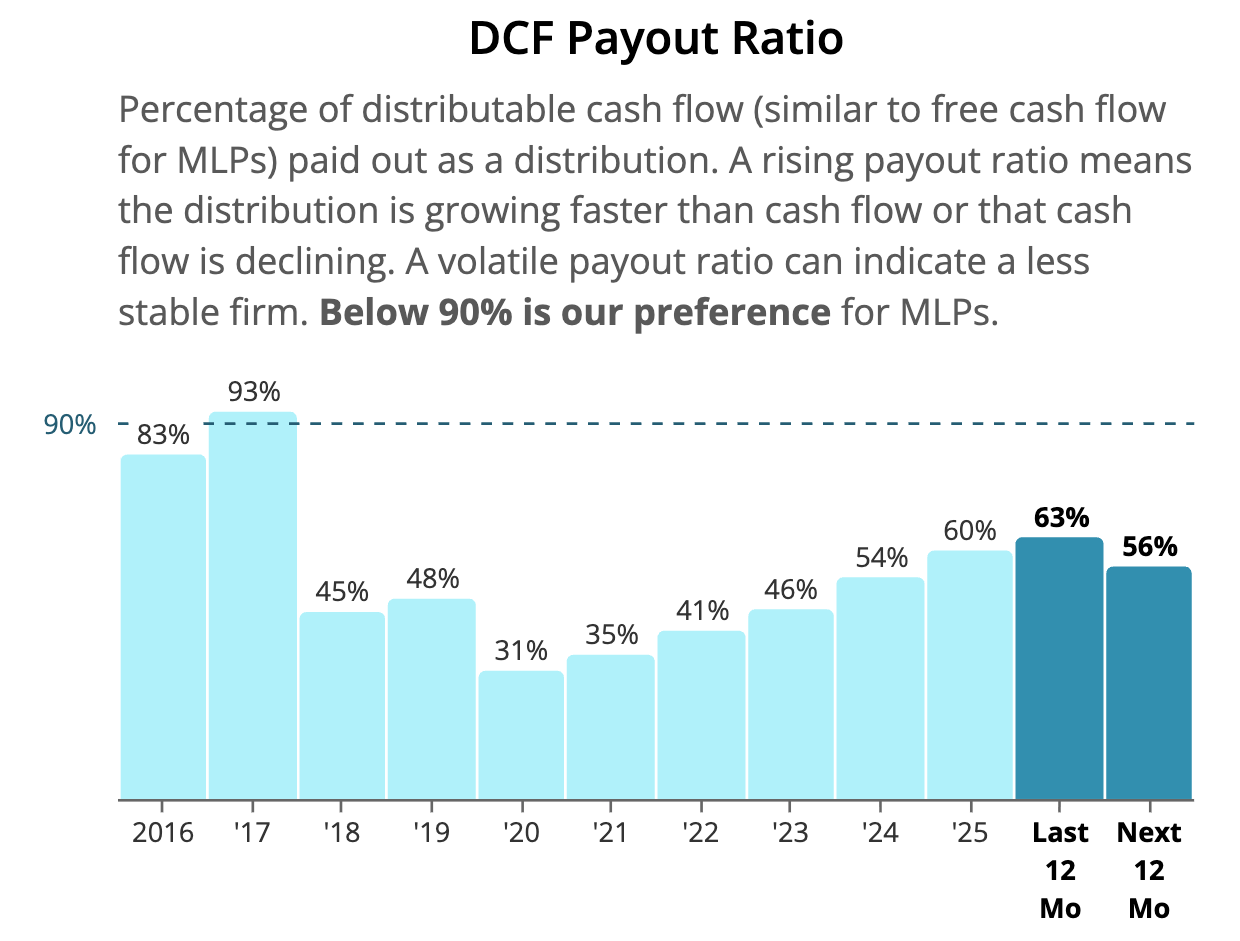
Plains cut its distribution three times from 2016 to 2020 to repair its balance sheet, but today its finances look much stronger. Its net debt is 2.6 times EBITDA, the lowest of these five partnerships, and its payout ratio sits at a healthy level near 60%.
Plains All American Pipeline's distributable cash flow payout ratio. Source: Simply Safe Dividends.
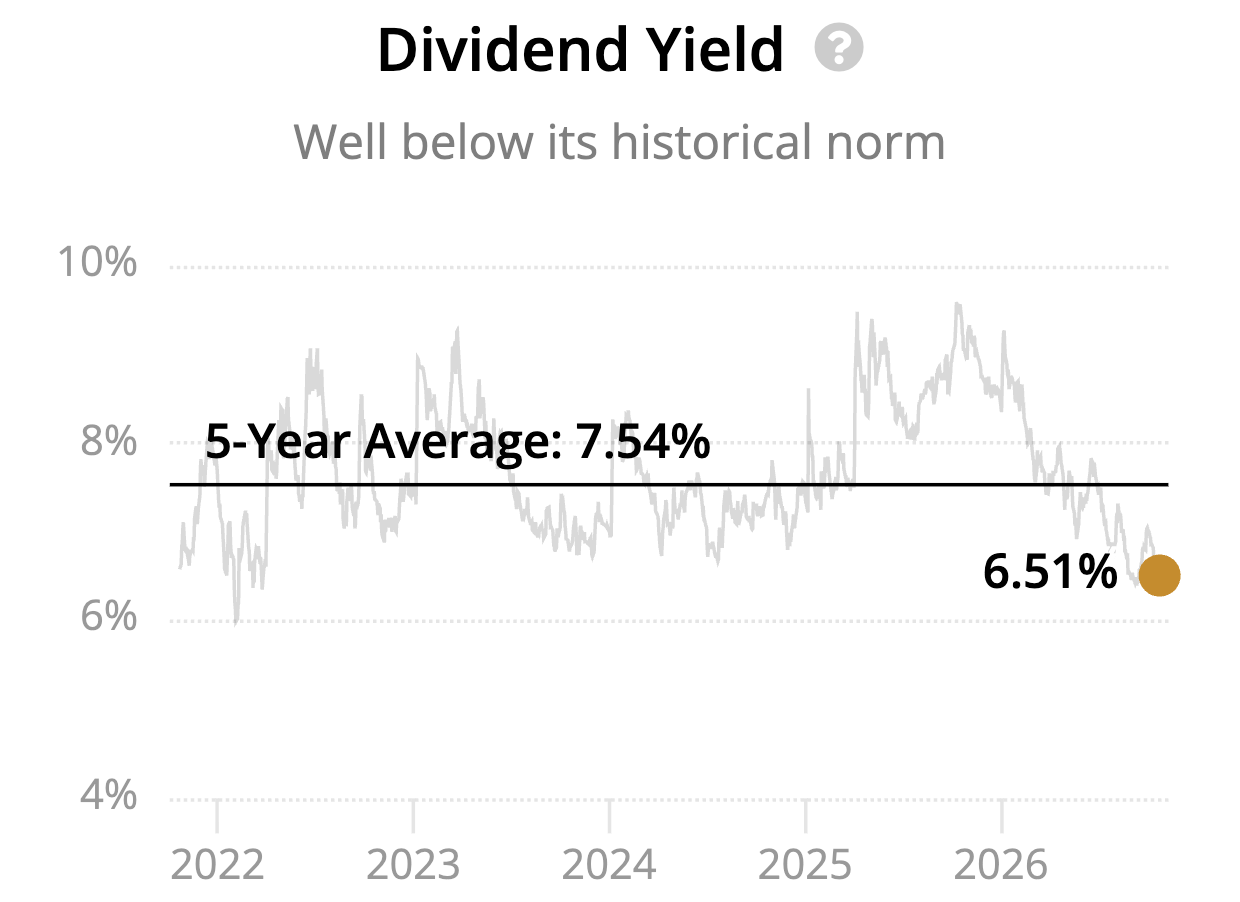
A faster-growing payout has pulled investors in. Plains yields about 6.5%, a full point below its five-year average of 7.5%, even after raising its distribution about 10% over the past year.
Plains All American Pipeline's dividend yield compared with its five-year average. Source: Simply Safe Dividends.
List of Oil and Gas Gathering and Processing MLPs
Gathering and processing (G&P) MLPs sit at the start of the midstream chain. Their pipelines collect natural gas from wells and bring it to processing plants that remove impurities.
Most G&P MLPs earn fixed fees tied to production from dedicated wells or acreage. But volumes can drop when producers drill fewer wells in a downturn, which makes their cash flow less predictable than a long-haul pipeline's.
Here is our analysis of each G&P MLP, ranked from our most to least favorite business:
Western Midstream Partners (WES) generates about 60% of its revenue from Occidental Petroleum, which owns about 42% of the partnership, per its annual report. Its gathering and processing assets sit mainly in west Texas's Delaware Basin and Colorado's DJ Basin, and it has added water-handling and gathering assets through recent acquisitions. Mostly fee-based contracts, a BBB- credit rating and a payout ratio that is low for an MLP make it one of the stronger G&P options, though its reliance on one customer is hard to ignore.
USA Compression Partners (USAC) rents out the compression equipment that keeps natural gas moving through pipelines. It has kept its distribution flat or higher for more than 50 straight quarters, according to its August investor presentation, and it grew in January 2026 by buying J-W Power. But many of its contracts are short term, its credit ratings are below investment grade, and Energy Transfer controls its general partner. Conservative income investors are better served elsewhere.
NGL Energy Partners (NGL) has not paid a distribution on its common units since early 2021, when its lenders required it to reduce debt. Its latest annual report says the board expects to evaluate reinstatement "in due course," but redeeming its preferred units comes first. Until the common payout returns, NGL offers nothing for income investors.
List of Oil and Gas Pipeline MLPs
Most of the MLPs in this group own long-haul pipelines, terminals and storage. Compared with gathering systems, these assets tend to produce steadier cash flow because their contracts often include minimum volume commitments.
Here is our analysis of pipeline MLPs, ordered from our most to least favorite business:
Enterprise Products Partners (EPD) is the highest-quality partnership in this group, in our view, with assets connected to nearly every U.S. shale basin, an A- credit rating and 27 straight years of distribution raises. See its full write-up above.
MPLX (MPLX) pairs fee-based pipelines serving Marathon Petroleum with a natural gas processing business. Marathon's roughly 64% stake gives it control, which brings both stability and concentration risk. See its full write-up above.
Energy Transfer (ET) has one of the largest pipeline networks in the country and a BBB credit rating, and it has raised its distribution steadily since its 2020 cut. See its full write-up above.
Plains All American Pipeline (PAA) focuses on crude oil, especially in the Permian Basin, and has the lowest leverage of the five MLPs we highlight above. See its full write-up above.
Delek Logistics Partners (DKL) provides pipelines, tanks and terminals for refiner Delek US Holdings, which owns about 63% of its units, per its latest quarterly report. Minimum volume commitments back much of its business, and it has raised its distribution every year since going public in 2012. But its heavy reliance on Delek and a single region makes it less attractive than larger pipeline MLPs.
Genesis Energy (GEL) moves crude oil through offshore pipelines in the Gulf of Mexico. It sold its soda ash business in February 2025 for about $1 billion of net proceeds, per its annual results, which leaves it focused on offshore pipelines. Genesis has cut its distribution twice since it was formed in 1996, its contracts offer little volume protection and its credit ratings are well below investment grade, which keeps it a speculative choice.
List of Other Midstream MLPs
These midstream MLPs work outside the traditional gathering and pipeline businesses.
Cheniere Energy Partners (CQP) exports liquefied natural gas from its Sabine Pass terminal under long-term, take-or-pay contracts, and S&P raised its credit rating to BBB+ in November 2025. See its full write-up above.
Martin Midstream Partners (MMLP) provides terminals, storage and transportation for petroleum products, sulfur and natural gas liquids. Its distribution has been next to nothing after a series of cuts that began in 2015, and a planned buyout by its sponsor, Martin Resource Management, was called off in December 2024. With little volume protection, small scale and costly debt, it should be avoided by most investors.
List of Non-Oil and Gas Commodity MLPs
These MLPs produce commodities other than oil and gas. Their cash flow tends to follow the prices of what they sell, which makes for less reliable distributions.
Westlake Chemical Partners (WLKP) sells nearly all of its ethylene to its sponsor, Westlake. The two renewed their supply agreement in late 2025, extending it through 2027 with automatic one-year renewals after that. The contract keeps cash flow steady for now, but investors need to be comfortable with a single customer that also controls the partnership.
Alliance Resource Partners (ARLP) mines coal sold mainly to U.S. electric utilities and industrial users. It cut its distribution in July 2025 and has held it there since. The long-term shift away from coal, volatile coal prices and a history of payout cuts make it a poor fit for investors seeking stable income.
CVR Partners (UAN) makes nitrogen fertilizer at plants in Kansas and Illinois for farmers growing corn and wheat. It pays out whatever cash it generates each quarter, so its distribution swings widely with fertilizer prices, as its 2026 payouts show. Income investors looking for predictability should look elsewhere.
List of Fuel Distribution MLPs
Gas stations across the country depend on a steady supply of motor fuel. Most fuel distribution MLPs meet that need by delivering gasoline and diesel to stations on a wholesale basis.
Fuel demand is usually stable, but margins can swing, and wider adoption of electric vehicles clouds the long-term outlook.
Sunoco (SUN) is one of the largest independent fuel distributors in the U.S. and grew much bigger after buying Canada's Parkland in October 2025. A new corporation, SunocoCorp (SUNC), holds Sunoco units and pays the same distribution without a K-1. Sunoco has raised its payout seven quarters in a row and targets at least 5% annual growth, per its second-quarter results. Its BB+ credit rating and Energy Transfer's control of its general partner are the main risks.
CrossAmerica Partners (CAPL) distributes motor fuel from Exxon Mobil, BP, Shell and other suppliers to gas stations, and it leases and runs convenience stores. Its distribution has been flat for years but was well covered in the second quarter of 2026, and the partnership continues to sell sites, per its quarterly results. CrossAmerica has no credit rating, so investors are relying on management's discipline and a general partner owned by its founder.
Suburban Propane Partners (SPH) distributes propane, mostly for home heating, water heating and cooking. Weather and the economy drive its results, and high debt contributed to a 50% distribution cut in 2020. It has raised the payout modestly since, but it suits investors comfortable with seasonal swings better than those seeking dependable income.
Global Partners (GLP) owns gas stations in the Northeast, runs fuel terminals and distributes fuel wholesale. That mix diversifies its cash flow, but its terminal business is sensitive to oil prices, and it cut its distribution after oil prices plunged in 2016 and again in 2020.
List of Royalty MLPs
Rather than run a business, royalty MLPs own mineral rights and collect payments as producers extract oil, gas or coal from their land.
The model has high margins and usually little debt, but cash flow moves directly with commodity prices and drilling activity. These MLPs suit investors who want commodity-linked income and can live with volatile payouts.
Dorchester Minerals (DMLP) owns royalty interests tied mainly to oil, with natural gas a smaller share. The debt-free partnership pays out all available cash each quarter, so its distribution falls when oil prices and drilling slow and has historically recovered when the energy market rebounds.
Black Stone Minerals (BSM) is one of the largest U.S. owners of oil and gas mineral and royalty interests, with a tilt toward natural gas. It cut its distribution 20% in 2025 and raised it 7% in 2026, per its second-quarter results, a reminder that its payout follows energy prices.
Natural Resource Partners (NRP) collects royalties tied mostly to coal production on its mineral acreage. It has nearly paid off its debt, and its CEO says it is on track to retire the rest and significantly raise distributions before year-end, per its second-quarter results. Coal's long-term decline still clouds the outlook.
List of Investment and Real Estate MLPs
These partnerships invest in securities, bonds or real estate rather than energy assets. Their results track financial markets or interest rates, which can make them volatile.
New England Realty Associates (NEN) owns apartment buildings in the Boston area and looks more like a REIT than a typical MLP. It has paid uninterrupted distributions since 1988, but its low yield and small size are unlikely to interest investors seeking high income.
AllianceBernstein Holding (AB) earns fees managing stock and bond portfolios for institutions and individuals. It pays out all of its available cash flow each quarter, so its distribution rises and falls with assets under management and financial markets, per its second-quarter results.
Greystone Housing Impact Investors (GHI) owns mortgage revenue bonds that finance affordable multifamily housing. Its use of leverage contributed to a 52% distribution cut in 2020, and it has cut its payout by more than half over the past year as it exits multifamily joint-venture investments, per its filings. Its sensitivity to interest rates resembles a mortgage REIT's, a space we prefer to avoid.
Icahn Enterprises (IEP) is a holding company controlled by billionaire Carl Icahn, with investments concentrated in energy, automotive and a few other industries. It halved its distribution in 2023 and again in late 2024, and unitholders receive new units instead of cash unless they elect otherwise, per its latest distribution announcement. Conservative income investors should look elsewhere.
Frequently Asked Questions
What are MLP stocks? Master limited partnerships are publicly traded partnerships that combine the tax treatment of a private partnership with the liquidity of a stock. Most own energy infrastructure, pay out most of their cash flow as distributions and send investors a K-1 instead of a 1099. We count 25 MLPs that issue K-1s on major U.S. exchanges.
How many MLPs are there? We count 25 publicly traded MLPs that issue K-1s, excluding partnerships taxed as corporations and those traded over the counter. The number keeps falling as partnerships convert to corporations, as Brookfield Business Partners did in March 2026.
What is the safest MLP stock? Enterprise Products Partners (EPD) is the only MLP on our list with a Safe Dividend Safety Score. It carries an A- credit rating, has raised its distribution for 27 consecutive years and paid out 53% of its distributable cash flow over the past 12 months.
What are the best MLPs for income? Our five favorites are Enterprise Products Partners (EPD), Cheniere Energy Partners (CQP), MPLX (MPLX), Energy Transfer (ET) and Plains All American Pipeline (PAA). All five carry investment-grade credit ratings and pay out less than 80% of their distributable cash flow.
Can you hold MLPs in an IRA? You can, but it is often not ideal. MLPs can generate unrelated business taxable income (UBTI), and an IRA with $1,000 or more of it in a year must file a tax return and may owe tax. Our MLP tax guide explains why many investors keep MLPs in taxable accounts.
Do MLPs pay qualified dividends? No. MLP distributions are usually treated mostly as a return of capital, which lowers your cost basis and defers tax until you sell your units. That differs from the qualified dividends most corporations pay, which are taxed each year.
Why are MLPs converting to corporations? Many funds and investors cannot or prefer not to own partnerships because of K-1 tax reporting. Converting broadens the investor base, attracts index and ETF buyers and simplifies taxes, which is why Brookfield Infrastructure and Brookfield Renewable plan to become corporations by the end of 2026.
Closing Thoughts on the List of MLP Stocks
Our MLP list spans everything from oil pipelines to fuel distributors, coal miners and investment managers. Cash flow stability, leverage, distribution coverage, scale and governance vary widely, so each partnership deserves a close look before it goes into an income portfolio.
Pipeline MLPs with investment-grade balance sheets pay some of the most dependable distributions in the group. Higher yields are available elsewhere, but usually with more risk of a cut.