
How to Live Off Dividends and How Much You Need to Retire
To live off dividends, you need a portfolio whose dividend income covers whatever your Social Security, pension and other income do not. At a 4% yield that takes about 25 times the income you want, so $1 million produces roughly $40,000 a year without selling a single share.
The harder question is what yield you can earn safely. Of the 866 dividend stocks we rate, 412 earn a Safe or Very Safe Dividend Safety Score. Only 45 of them yield 4% or more, and just four yield above 6%.
That is why we think a starting yield between about 3.5% and 4.5% is the practical range for a retirement portfolio. Push much higher and you take on more risk of a dividend cut, slower income growth, or a portfolio crowded into a few sectors.
Below we cover how the strategy works, how much you need, what yield is realistic, and the pitfalls that trip up income investors. We also built a $1 million example portfolio that yields 4.4% using only stocks we rate Safe or better.
Prefer to watch? Check out our YouTube video, Building a 5% Dividend Portfolio Using Only Aristocrats & Kings.
How Living Off Dividends Works
Living off dividends means you spend the cash your companies pay out and leave the shares alone. Housing, food, healthcare and travel get paid from income, not from selling stock.
That matters most when markets fall. A retiree who funds spending by selling shares has to sell more of them when prices are down, which locks in losses early in retirement. Dividends from durable businesses tend to be far steadier than share prices, so a dividend investor can usually leave the portfolio alone through a bear market.
Dividends also tend to grow. Most quality companies raise their payouts as their profits rise, which helps income keep pace with living costs. Consumer prices rose 3.7% over the 12 months through September, according to the Bureau of Labor Statistics, and Social Security benefits will rise 3.6% in January.
Bonds work differently. The 10-year Treasury yielded 5.13% on October 21, per the Treasury Department's daily rates, which is more than most safe dividend stocks pay today. But a bond's coupon never rises, so its buying power shrinks every year. Many retirees hold some of each, and we compare the two in Dividend Stocks vs. Bonds for Retirement Income.
Living off dividends is not a shortcut to retirement. It still takes a large portfolio, which raises the obvious next question.
How Much You Need Invested to Live Off Dividends
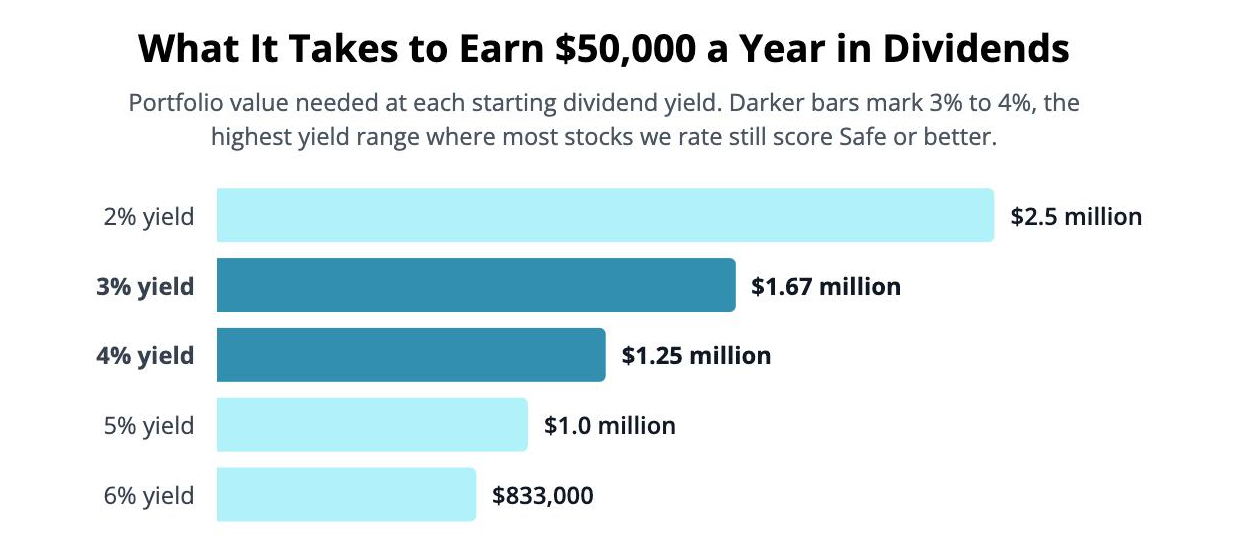
The math is simple. Divide the annual income you want from dividends by your portfolio's yield. Needing $50,000 a year takes $1.25 million at a 4% yield and $1.67 million at 3%.
Put another way, a 3.5% yield needs about 29 times your income target, a 4% yield needs 25 times, and a 4.5% yield needs about 22 times. The chart below shows how quickly the required nest egg shrinks as the yield rises, which is exactly why higher yields are so tempting.
Most retirees do not need their portfolio to cover everything. Households headed by someone 65 or older spent an average of $61,432 in 2024, before income taxes, according to the Bureau of Labor Statistics Consumer Expenditure Survey. Social Security will pay a retired couple who both collect benefits an average of $3,355 a month in January 2027, or about $40,260 a year, per the Social Security Administration.
That leaves a gap of roughly $21,000 a year. A portfolio of about $530,000 yielding 4% would cover it. Your own spending, benefits and tax bill will differ, and we work through the full calculation, including taxes, in How Much Do I Need to Retire on Dividends?
Whatever the target, the yield you assume does most of the work. So it is worth checking what yield is actually available without reaching for risky dividends.
What Dividend Yield Is Safe for Retirement Income?
Most articles on this subject assume a yield and move on. We can test it, because we score the dividend safety of every company we cover.
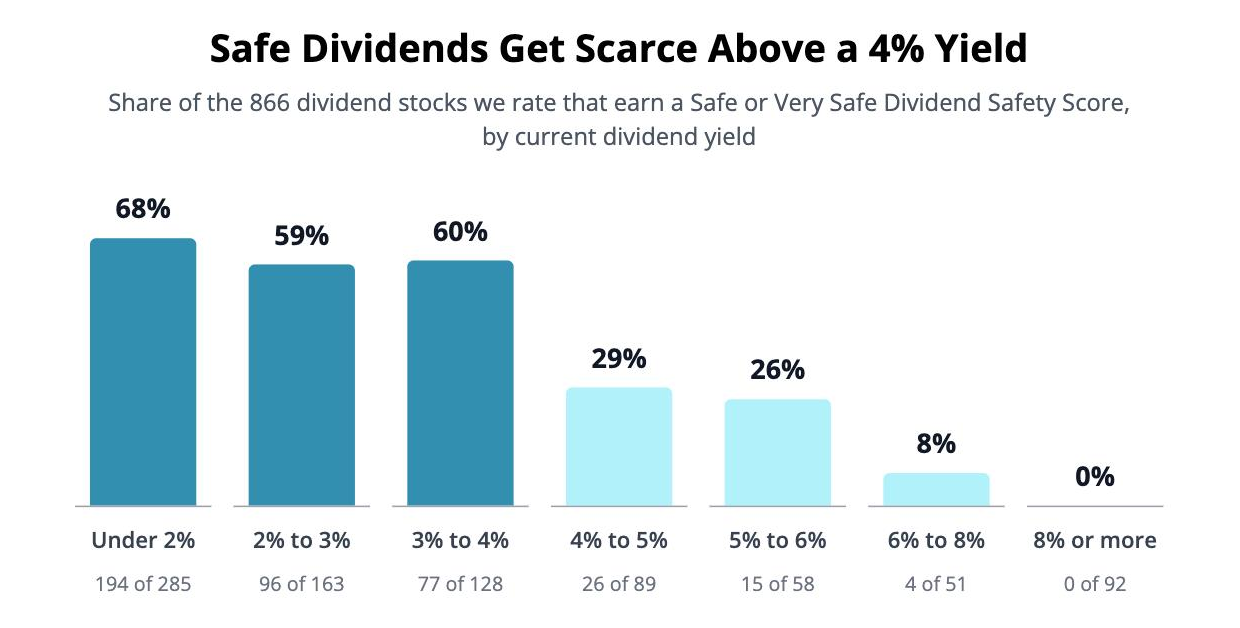
Of the 866 companies we rate today, 412 score Safe or better, meaning a Dividend Safety Score above 60. Inside that group, 122 yield at least 3%, 80 yield at least 3.5%, 45 yield at least 4%, and 19 yield at least 5%.
The drop-off comes right around 4%. Below that level, roughly six in 10 of the stocks we rate earn Safe or Very Safe scores. Between 4% and 6%, fewer than three in 10 do. Above 8%, none of the 92 stocks we rate does.
A high yield is often the market's way of pricing in risk. A company whose profits are shrinking or whose debt is climbing sees its stock fall, which pushes the yield up even before anything happens to the dividend.
Raise the bar to Very Safe, a Dividend Safety Score above 80, and the list gets very short. Only 13 of those companies yield 3.5% or more, and just one, Public Storage, yields above 4%.
We have scored dividends this way since 2015. Investors who stuck with companies rated Safe or better would have avoided 925 of the 946 dividend cuts that have occurred since then, or 97%, according to our public Dividend Safety Score track record.
Higher Yields Usually Mean Slower Dividend Growth
Safety is not the only thing a high yield can cost you. Among the stocks we rate Safe or better, those yielding under 2% have grown their dividends at a median of 8.7% a year over the last five years. Those yielding 3% to 4% grew theirs at 5.2%, and those yielding 4% or more at 4.5%.
That gap matters over a long retirement. With prices rising about 3.7% a year lately, income that grows at 4.5% barely stays ahead of inflation, while income growing at 6% or 7% steadily gains buying power.
We saw this trade-off firsthand when we built a 5% yielding portfolio using only Dividend Aristocrats and Kings. When we put it together in November 2025, its 20 stocks yielded 4.97%, and about 70% of its income came from companies we rated Safe or better. But its income had grown 4% a year over the prior five years and was tracking below 3% that year, which is why we walked through the slow dividend growth problem in our video.
Much of that slowdown came from consumer staples, which made up nearly half of the portfolio. Shoppers trading down to store brands have squeezed profits at many packaged food and household products makers, and their dividend raises have shrunk with them. A portfolio built to hit a high yield can end up leaning heavily on one struggling industry without anyone intending it.
Why High-Yield Portfolios End Up Concentrated in a Few Sectors
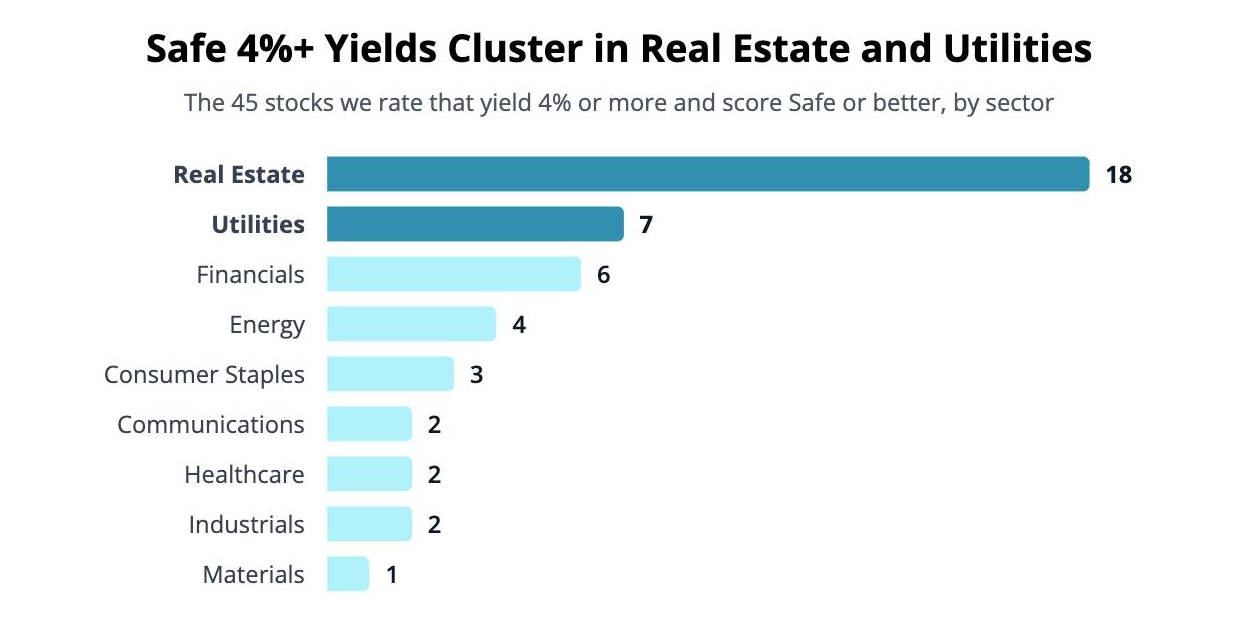
That concentration problem shows up across our whole universe. Of the 45 stocks we rate that yield at least 4% and score Safe or better, 18 are real estate investment trusts (REITs) and seven are utilities. Together those two sectors account for more than half the list.
REITs and utilities pay out most of their cash by design, so their yields run high. They also share a weakness. When safe bonds pay more, investors demand higher yields from these stocks, which pushes their prices down, and higher borrowing costs make it harder for them to grow. With the 10-year Treasury above 5%, a portfolio built mostly from these two sectors can lag for a long time.
Outside of businesses built to pay out most of their cash, a high yield more often signals that something is structurally wrong or that the dividend may need to be cut. Those situations can lead to a permanent loss of capital, not just a temporary dip in income.
Capping how much of a portfolio goes into any one sector solves most of this. The example below shows that it does not cost much income to do so.
A $1 Million Example Portfolio Yielding 4.4%
To show what a diversified retiree can earn today, we built a sample portfolio in our online tools. Every stock had to score Safe or better, yield at least 3%, have paid uninterrupted dividends for at least 20 years, and have raised or held its dividend through the 2007-09 financial crisis.
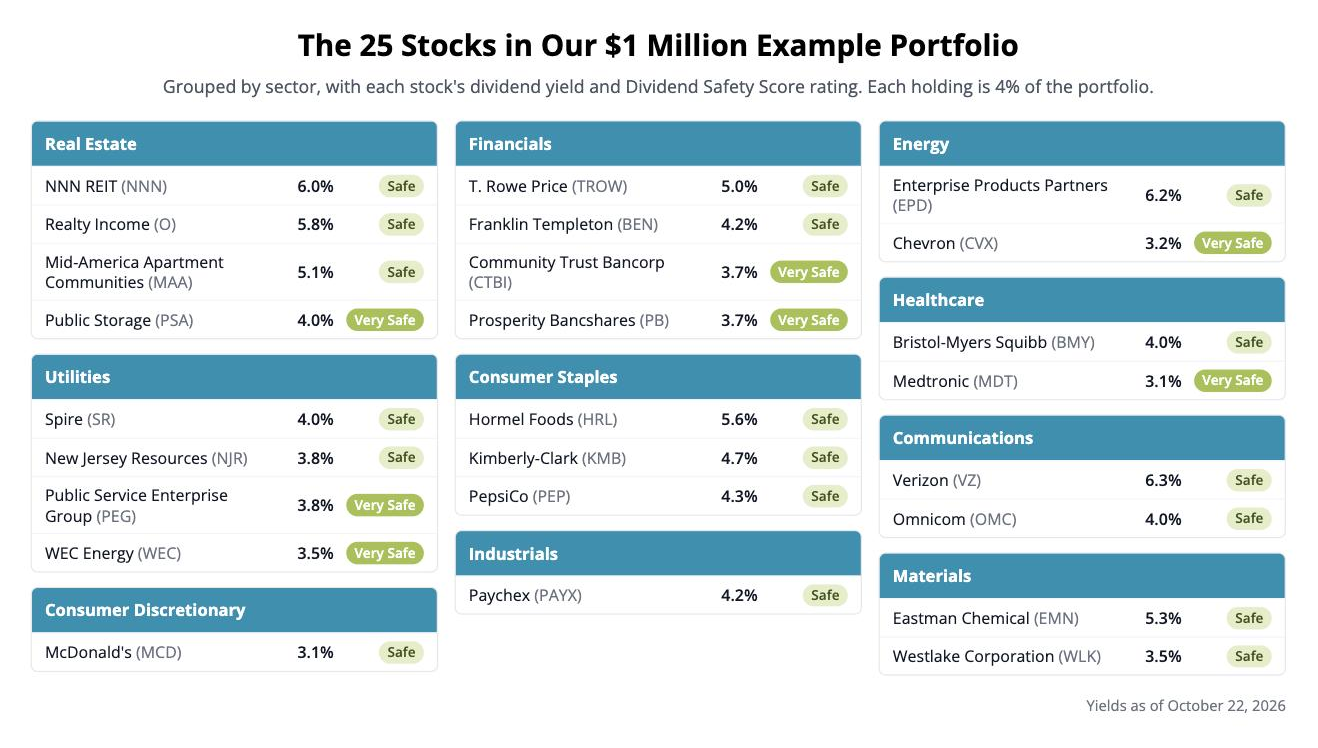
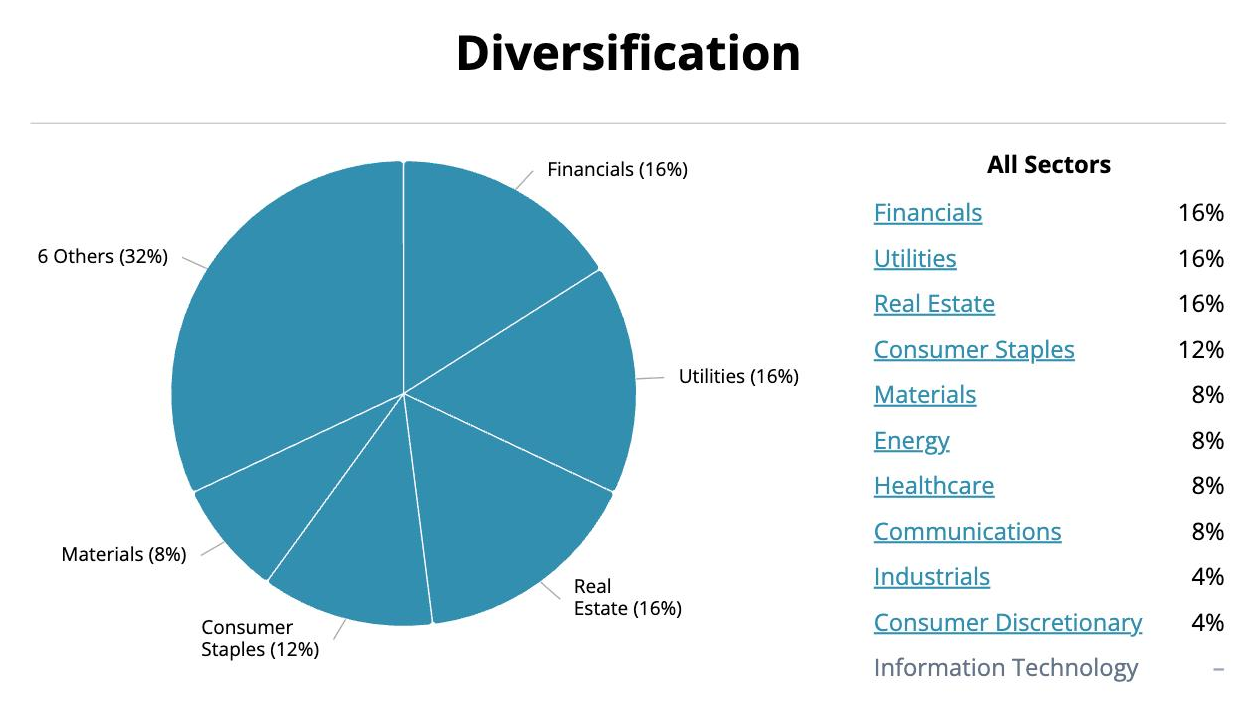
From that list we picked 25 stocks across 10 sectors, with no more than four from any one sector. We favored U.S. companies to avoid foreign tax withholding and put an equal $40,000 in each.
The portfolio mixes household names such as PepsiCo, McDonald's, Verizon and Chevron with less familiar utilities, regional banks and real estate investment trusts. Here are all 25 holdings by sector, with each one's yield and Dividend Safety Score rating.
Invested at $1 million in October 2026, the portfolio pays $44,449 a year, a yield of about 4.4%. Its main numbers are summarized below.
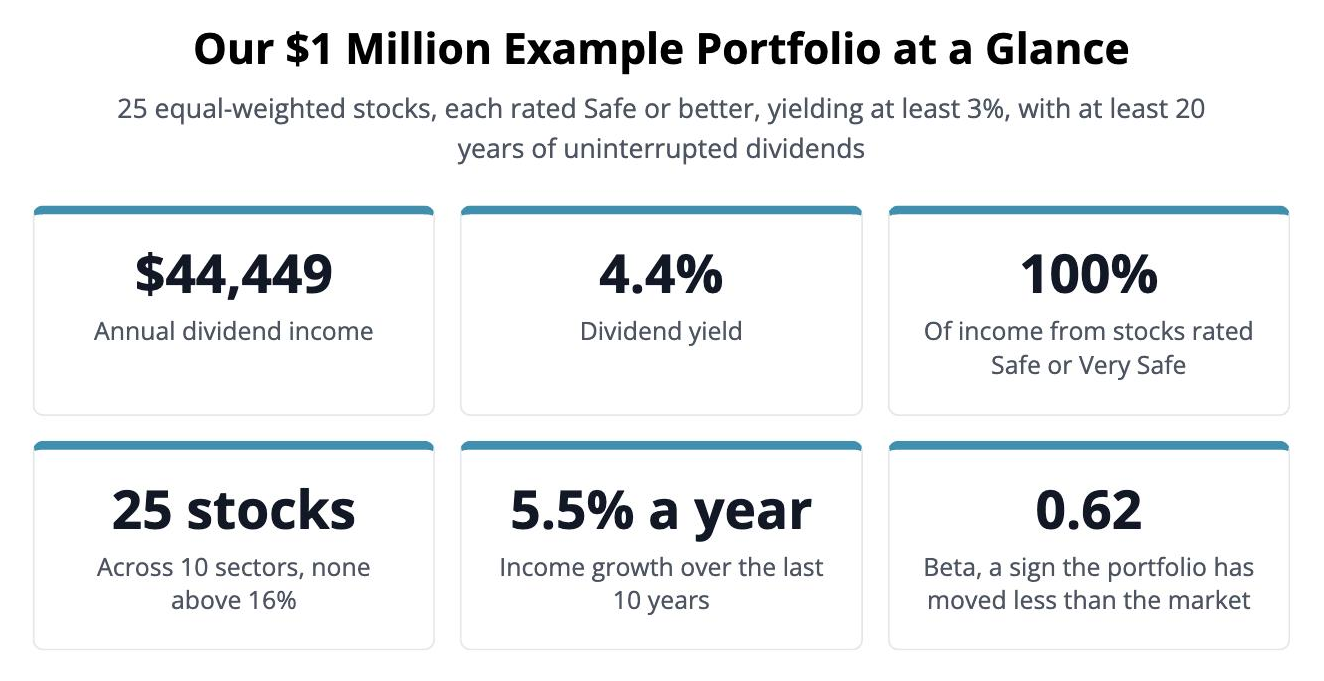
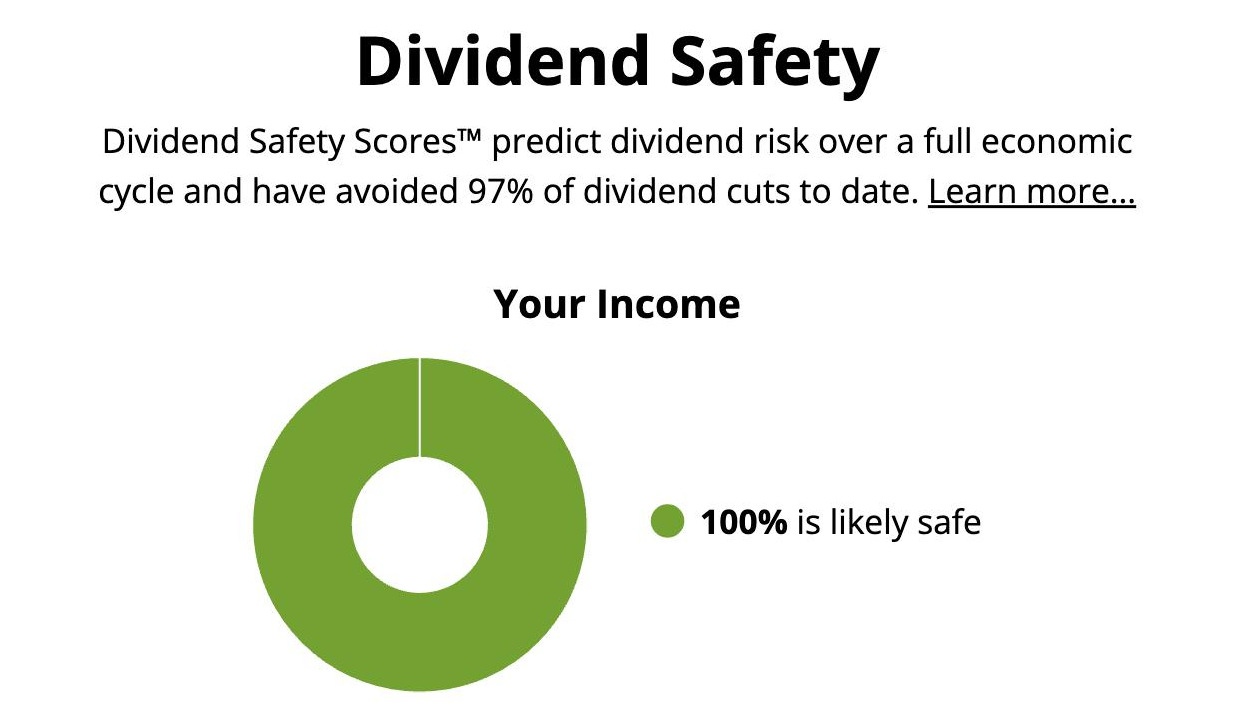
Every dollar of that income comes from companies we rate Safe or Very Safe. We expect more than 90% of companies with those ratings to maintain their dividends over a full economic cycle. The portfolio's beta of 0.62 also means it has tended to move less than the overall market.
No sector makes up more than 16% of the portfolio. Real estate, utilities and financials each hold four positions, and no single stock provides more than about 6% of the income.
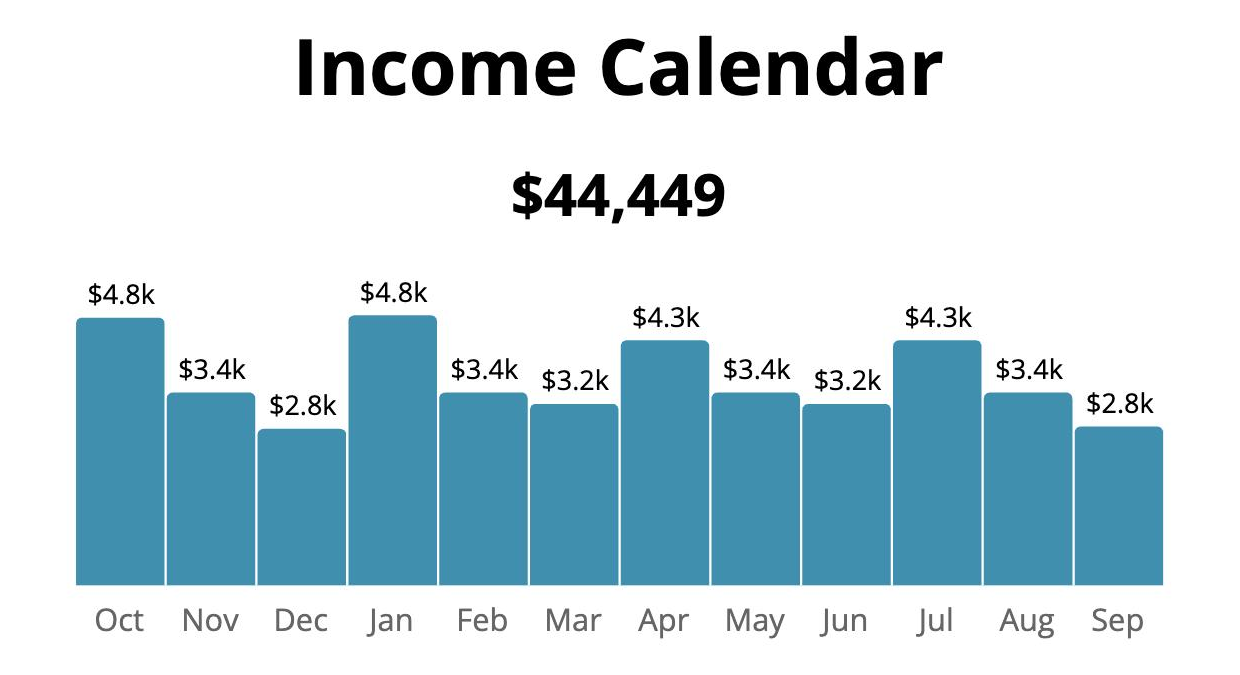
Because the holdings pay on different schedules, cash arrives every month. Over the next 12 months, monthly income ranges from about $2,800 in December and September to about $4,800 in October and January, an average of roughly $3,700.
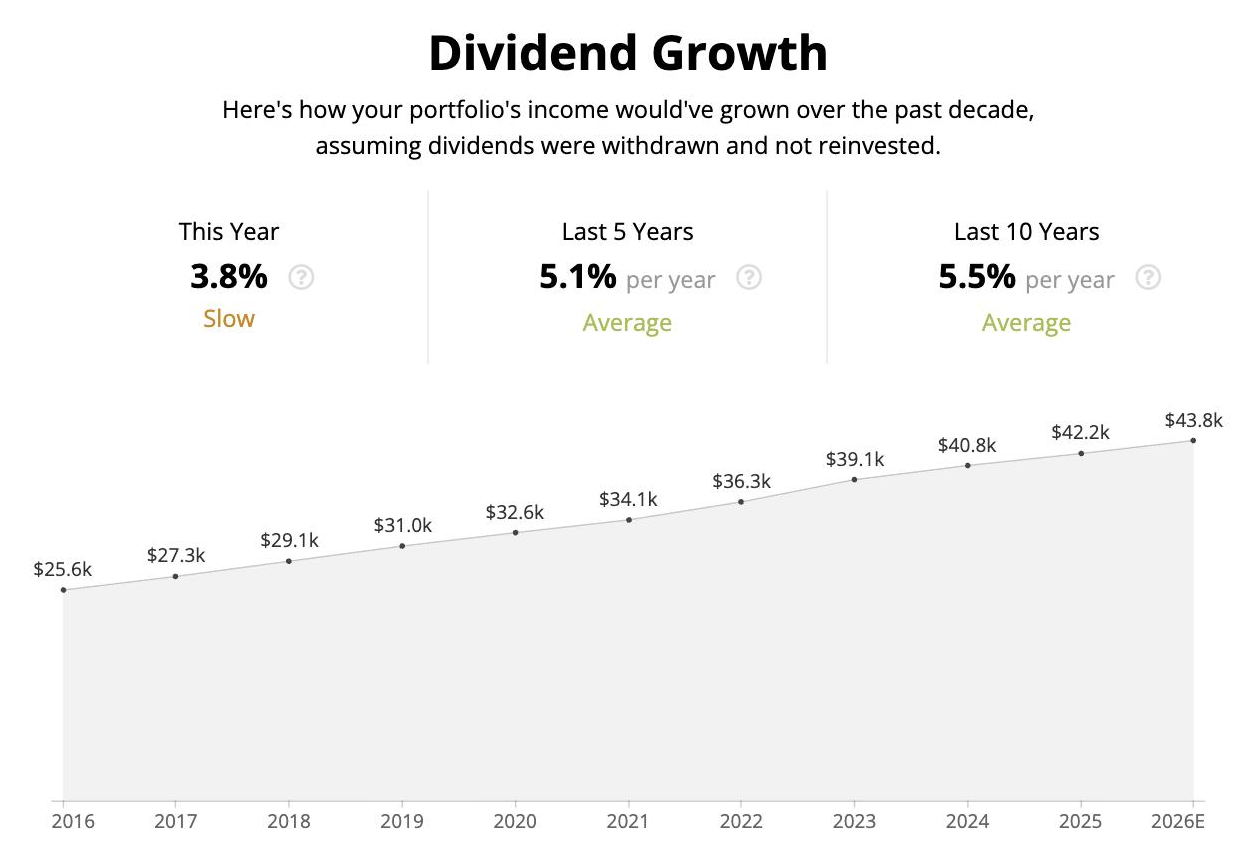
The income has also grown. Had you owned these 25 stocks for the past decade and spent every dividend, your annual income would have risen from about $25,600 in 2016 to an estimated $43,800 this year. That works out to 5.5% a year over 10 years and 5.1% a year over the last five.
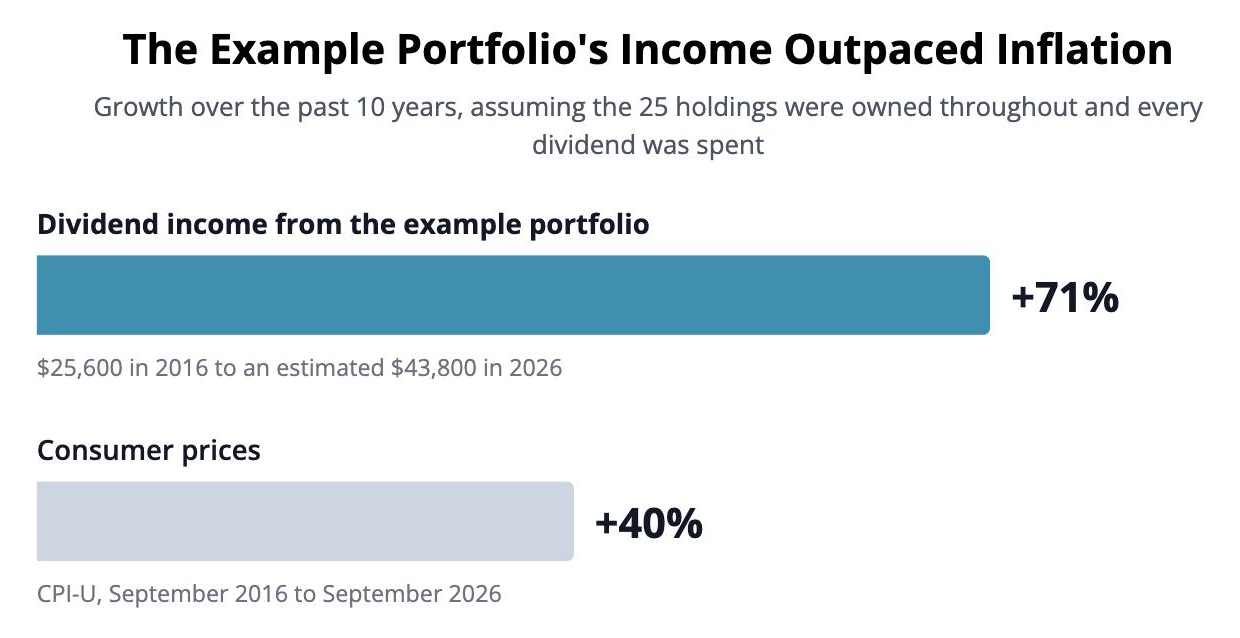
That growth comfortably outpaced inflation. Consumer prices rose about 40% over the same 10 years, based on the BLS figures above, while this income rose about 71%.
Keep in mind that this looks back at today's holdings. A portfolio built in 2016 would not have known which companies would hold up best.
Two practical notes. Enterprise Products Partners is a partnership that sends investors a K-1 tax form rather than a 1099, and REIT dividends are mostly taxed as ordinary income, so many investors hold those types of stocks in an IRA.
This is an illustration, not a recommendation to buy these exact stocks. We cover the full process of choosing and weighting holdings in How to Build a Dividend Portfolio. If you are comfortable with a little more risk, our list of high dividend stocks yielding 4% to 10% is a good place to look for ideas.
Individual Stocks or Dividend Funds?
A portfolio like this can be built from individual stocks, funds, or a mix of the two. Dividend mutual funds and ETFs offer low fees, instant diversification and simplicity, and for many investors they are set-it-and-forget-it holdings.
What fund investors give up is control. Most dividend funds own hundreds of companies. Some are good businesses with safe dividends, while others will put their payouts on the chopping block in the next downturn. A broad index fund also pays little income on its own, since the S&P 500 yields only about 1.05%, according to Multpl.
Vanguard's High Dividend Yield ETF (VYM) shows what can happen when a fund is not built around dividend safety. Its distributions fell from $1.44 per share in 2008 to $1.09 in 2010, a drop of about 24%, and did not reach a new high until 2012, based on its distribution history. Most funds also pay variable amounts that change each quarter, which makes monthly budgeting harder.
None of that rules funds out. But owning individual stocks lets you set your own level of risk, avoid the companies you consider fragile, and know exactly how much each holding pays and when. Most companies pay fixed dividends quarterly or monthly, and we list the most reliable monthly payers in our guide to monthly dividend stocks.
Common Pitfalls When Living Off Dividends
The biggest pitfall is chasing yield, which the sections above cover. A close second is assuming that a long dividend record guarantees the future.
The S&P 500 Dividend Aristocrats, companies that have raised their dividends for at least 25 straight years, are popular for good reason. Yet of the 60 Aristocrats that existed in 2007, 16 cut or suspended their dividends during the financial crisis. Banks accounted for most of those cuts, and it is never easy to predict which industry will take the next shock.
The pandemic was another reminder. With the U.S. economy contracting at a record pace, 333 of the 1,313 companies we covered, or 25%, cut their dividends in 2020.
None of this invalidates dividend investing. It shows why it pays to own companies with strong balance sheets and time-tested businesses, to diversify, and to keep an eye on the dividend safety of everything you own. A cut you see coming is far easier to handle than one that arrives as a surprise.
The last trap is focusing on income at the expense of total return. A company that pays a dividend is not automatically a better investment, and its shares can still fall hard in a bear market. In theory, it should not matter whether your retirement cash comes from dividends, bonds or selling shares.
In practice, many retirees find that living off dividends and leaving their principal alone helps them tune out the noise of falling stock prices. That calm is worth a lot when the market drops early in retirement.
Frequently Asked Questions
How much do you need invested to live off dividends?
Divide the income you want from dividends by your portfolio's yield. That works out to about 25 times your income target at a 4% yield and about 29 times at 3.5%. Someone who needs $50,000 a year from dividends needs about $1.25 million at a 4% yield.
Divide the income you want from dividends by your portfolio's yield. That works out to about 25 times your income target at a 4% yield and about 29 times at 3.5%. Someone who needs $50,000 a year from dividends needs about $1.25 million at a 4% yield.
Can you live off dividends of $1 million?
For many retirees, yes. A $1 million portfolio yielding 4% pays about $40,000 a year, and our example portfolio of 25 stocks rated Safe or better pays $44,449 a year on $1 million, a 4.4% yield. Combined with Social Security, that covers average spending for households headed by someone 65 or older.
For many retirees, yes. A $1 million portfolio yielding 4% pays about $40,000 a year, and our example portfolio of 25 stocks rated Safe or better pays $44,449 a year on $1 million, a 4.4% yield. Combined with Social Security, that covers average spending for households headed by someone 65 or older.
How much dividend income does $500,000 produce?
About $20,000 a year at a 4% yield, or $17,500 at 3.5%. That is close to the roughly $21,000 gap between what an average retired household spends and what a retired couple collects from Social Security.
About $20,000 a year at a 4% yield, or $17,500 at 3.5%. That is close to the roughly $21,000 gap between what an average retired household spends and what a retired couple collects from Social Security.
Can you live off dividends without selling shares?
Yes, if the portfolio is large enough relative to your spending and the dividends are dependable. Because you spend only the income, you are never forced to sell shares in a falling market to pay the bills.
Yes, if the portfolio is large enough relative to your spending and the dividends are dependable. Because you spend only the income, you are never forced to sell shares in a falling market to pay the bills.
What is a safe dividend yield for retirement?
We think about 3.5% to 4.5% for a diversified portfolio. Of the 866 companies we rate, 45 score Safe or better and yield at least 4%, but only four of those yield more than 6%. Yields far above 5% usually come with higher cut risk, sector concentration, or both.
We think about 3.5% to 4.5% for a diversified portfolio. Of the 866 companies we rate, 45 score Safe or better and yield at least 4%, but only four of those yield more than 6%. Yields far above 5% usually come with higher cut risk, sector concentration, or both.
Can you live off ETF dividends?
Yes, but fund payouts vary from quarter to quarter and can fall in a recession. Vanguard's High Dividend Yield ETF cut its distributions by about 24% between 2008 and 2010. Individual stocks give you more control over the safety and timing of your income.
Yes, but fund payouts vary from quarter to quarter and can fall in a recession. Vanguard's High Dividend Yield ETF cut its distributions by about 24% between 2008 and 2010. Individual stocks give you more control over the safety and timing of your income.
Can you retire early on dividends?
It is possible, but an early retiree needs income that grows faster than inflation for several decades. That argues for a lower starting yield with stronger dividend growth, which means a larger portfolio. Stocks we rate Safe or better that yield under 2% have grown their dividends at a median 8.7% a year over five years, versus 4.5% for those yielding 4% or more.
It is possible, but an early retiree needs income that grows faster than inflation for several decades. That argues for a lower starting yield with stronger dividend growth, which means a larger portfolio. Stocks we rate Safe or better that yield under 2% have grown their dividends at a median 8.7% a year over five years, versus 4.5% for those yielding 4% or more.
Do you pay taxes on dividends in retirement?
Yes. Qualified dividends from most U.S. companies are taxed at lower long-term capital gains rates, while REIT dividends are mostly taxed as ordinary income. Dividends can also affect how much of your Social Security is taxed, which we explain in How Do Dividends Affect Social Security Benefits?
Yes. Qualified dividends from most U.S. companies are taxed at lower long-term capital gains rates, while REIT dividends are mostly taxed as ordinary income. Dividends can also affect how much of your Social Security is taxed, which we explain in How Do Dividends Affect Social Security Benefits?
Closing Thoughts on Living Off Dividends
Living off dividends is less about finding the highest yields and more about building a durable portfolio of businesses that can pay and grow their dividends through many different economies. Today that means a starting yield near 4%, spread across many sectors, with every holding's dividend on solid ground.
Done well, it can provide steady, rising income alongside long-term growth, and a retirement that depends far less on what the stock market does in any given year.
We built Simply Safe Dividends to help investors do exactly that. Our online tools show the Dividend Safety Score of every stock you own, track your income and its growth, and alert you when a dividend changes. You can see how it works here. Thanks for reading!